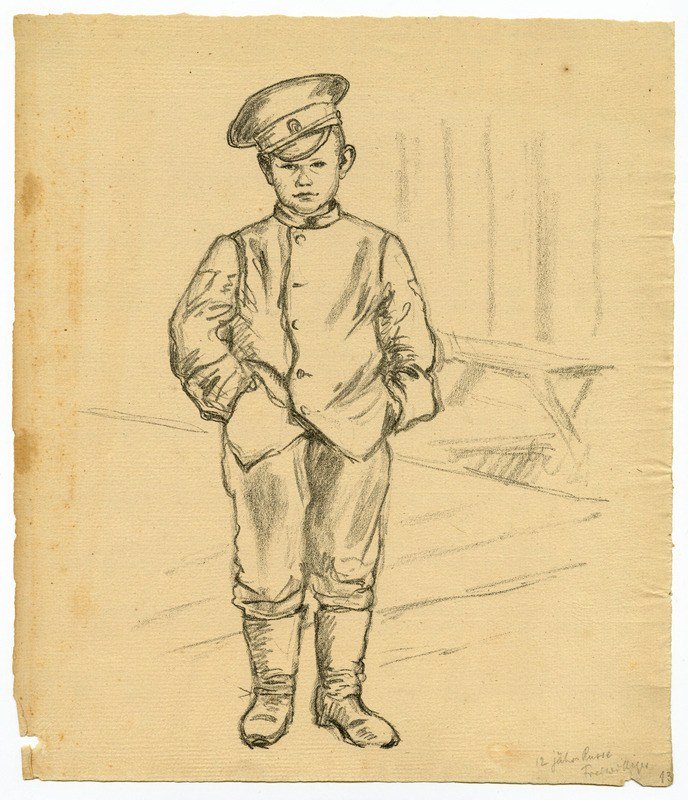
Among the drawings there is a child. Anton Matyszewski, 12 years old, is recorded as a volunteer from the Lomza district, 23rd Infantry Regiment. He stands in the camp yard in a uniform too big for him, boots, a peaked cap, hands in his pockets, and looks straight at the artist. In the corner of the sheet, in the artist's hand: "Russian, 12".
The artist is Hermann Struck, then an officer in the German Imperial Army, and later one of the three founders of Bank Mizrahi, today Mizrahi Tefahot Bank.
Who commissioned the drawings
According to the exhibition page that the Centrum Judaicum in Berlin, the Jewish institution of the synagogue on Oranienburger Strasse, devoted to Struck, the anthropologist Felix von Luschan commissioned Struck to draw the heads of the British and French prisoners in the Crescent Camp near Wünsdorf, in order to record their "racial features" (rassische Merkmale).
Hebrew Wikipedia describes the same project: a portfolio that Struck created between 1915 and 1916 "with the approval and support of the German General Staff", for which he turned to Luschan for advice "on a project that had anthropological aspects", and in which "an emphasis on racial features stands out".
Felix von Luschan (1854 to 1924) was one of the central figures of German physical anthropology, head of the Africa and Oceania department at the Ethnological Museum in Berlin, and from 1908 a member of the German Society for Racial Hygiene. He headed the physical anthropology section of the Royal Prussian Phonographic Commission, which was responsible for the prisoner-of-war project.
The camps
In 1915 the German prisoner-of-war camps were opened to anthropologists. About 175 camps were operating in Germany at the time. South of Berlin two special camps were set up: the Crescent Camp (Halbmondlager) at Wünsdorf and the Vineyard Camp (Weinberglager) at Zossen.
Muslim prisoners from North and West Africa and from India were concentrated at Wünsdorf, alongside Hindus and Sikhs. Estimates speak of about thirty thousand Arab, Indian and African prisoners who passed through the camp. In 1915 the Germans built a mosque there, the first on German soil, in the hope of recruiting the Muslim prisoners against Britain and France. Struck drew that mosque as well.
The documentation work was done in the camps: body measurements, plaster casts of faces, photography, and recordings of voices and singing. The Royal Prussian Phonographic Commission worked from December 1915 to December 1918, visited 29 of the 175 camps, and made 2,672 recordings of about 250 languages, dialects and traditional music. The commission had about thirty members. Luschan's work focused on body measurements of the prisoners at Wünsdorf.
What is written on the sheets
For this article 48 lithographs from the series were examined, from the collection of the Leo Baeck Institute in New York. The sheets do not carry the caption of a work of art. They carry a record.
The fullest example is the portrait of a 56-year-old Bedouin. At the top of the sheet, on the right, his name is written in Arabic by hand: محمد بن احمد, Mohammed ben Ahmed. At the bottom left, in Struck's hand and in German:
Mohammed ben Ahmed, Araber, Oulad Nail, Oulad Ben Abdilla aus Djelfa, Alg. 56 Jahr, Viehzüchter, Regt. Spahi
That is: name, "Arab", the name of the tribe (Oulad Nail), the name of the sub-tribe (Oulad Ben Abdilla), town of origin (Djelfa in Algeria), age, trade (cattle breeder) and regiment. Under the drawing, in pencil, Struck's signature.
Tribe and sub-tribe are not military data. They are an ethnographic classification.
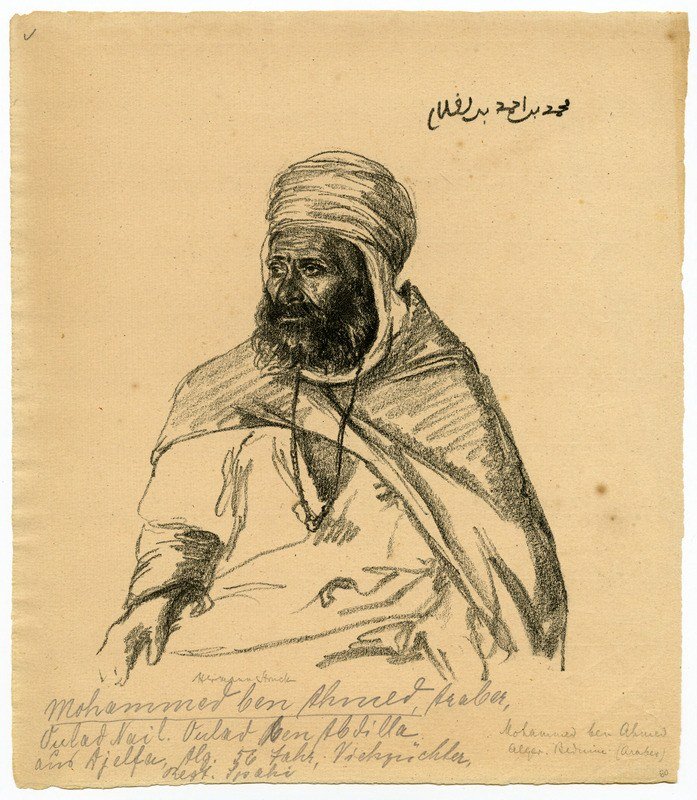
Arabic script in the prisoners' own hand is found on at least three sheets. On one of them: عبد القادر بن سليمان, Abd el-Kader ben Suleiman, a 30-year-old merchant from Oran, 6th Regiment of Algerian Tirailleurs. On the sheet of the Sikh Chandan Singh there is an inscription in Gurmukhi, the Punjabi script.
Who is there
Among the 48 sheets examined: seven Algerians, a Berber, a Bedouin, a "Black Algerian", a "Black Sudanese", a "Black Somali", a Christian Senegalese, a Nigerian, an "Arab" and an "African". From India: a Sikh, a Gurkha, a Garhwali and two Muslim Punjabis. From Russia: seven Russians, five Tatars, a Muslim Bashkir, an Armenian from Tiflis, a Georgian and a Russian German. From Europe: four Englishmen, two Frenchmen and a Pole.
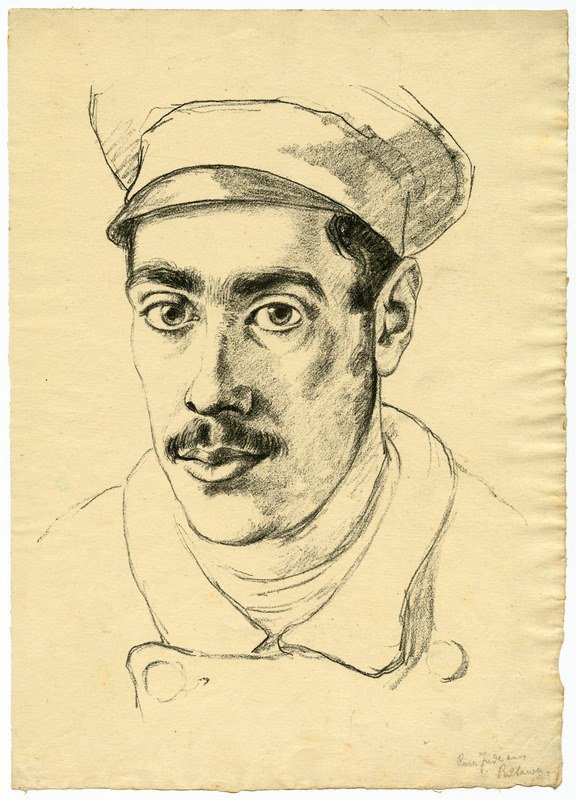
And two Jews. One, "Chaim Krasikow, a Jew from Lublin, Poltava province, 22 years old, bookkeeper, 39th Siberian Regiment". On his sheet Struck wrote in the corner: "Russian Jew from Poltava". The other is identified only as "Russian Jew from Odessa".
The book
The drawings were published in a book titled Kriegsgefangene, Prisoners of War, with the added title "A contribution to ethnology in the World War. An introduction to the fundamentals of anthropology". Publisher: Dietrich Reimer, Berlin. The title page states that the book was published with the permission of the Royal War Ministry. It includes about 27 pages of introduction by Luschan, about 60 photographs classified as "race pictures", and 100 lithographs by Struck on 50 plates.
Sources differ on the year of publication. The auction houses Ketterer and Bassenge, as well as the academic research, give 1916. The Jewish museum in Paris, the Tübingen University Library and the Leo Baeck Institute give 1917. The plausible explanation is a first edition in 1916 and a further issue in 1917, but this has not been verified.
Where the drawings are today
At the Leo Baeck Institute in New York, in the prisoner-of-war series. At the Musée d'art et d'histoire du Judaïsme in Paris, which holds a copy of the book and tags it in its catalogue "Anthropologie raciste", racist anthropology. And at the Hermann Struck Museum in Haifa, in the house where he lived, where they are shown in the exhibition "Spirit and Matter".
The difference between the last two museums is the difference between two readings of the same sheets. In Paris they are tagged as racist anthropology. In Haifa, according to a review in the art magazine Portfolio, "what might have been disturbing from today's point of view and discourse in fact teaches of Struck's respectful attitude and of his humanist outlook". That review does not mention race, does not mention anthropology and does not mention Luschan.
What is documented and what is not
Documented: the commission, the purpose, the military permission, the classification on the sheets, and letters from Struck to Luschan from which it emerges, according to Margaret Olin's study, that he reworked some of his drawings so that they would fit Luschan's racial stereotypes. Olin gives an example: he told Luschan that he had corrected a drawing in order to give an African "beautiful, frizzy" hair. The primary source for the letters is the research of Andrew Evans.
And not documented, and it is important to say so: the same Olin also argues the opposite. In her account Struck restrained himself in the final version too, kept furthest from the stereotypes in the drawings of the Jews, drew his subjects directly or slightly from above so that the viewer is forced to meet their gaze, and in army uniform rather than prisoner's clothing, and he may have intended to attack the stereotypes, perhaps with Luschan's tacit consent. Luschan himself ended his introduction with a celebration of the unity of mankind, and according to the Ketterer catalogue opposed attempts to proclaim the superiority of an "Aryan" race over a "Jewish" one.
Likewise, no evidence was found that Struck's drawings were reprinted in the race literature of the 1930s.
What is documented later: in the same camps and in the same year Egon von Eickstedt carried out his first anthropological study, measuring Sikh prisoners. In 1927 he became editor of the "Archive for Race Pictures" (Archiv für Rassenbilder), and in the 1930s he was among the leading race researchers of the Third Reich. Luschan's collection of photographs served as a basis for that archive.
The link to the bank
Bank Mizrahi Ltd. was registered on 6 June 1923, company number 520000522, which is to this day the number of Mizrahi Tefahot Bank. The book had come out seven years earlier. Struck was one of the three founding shareholders, and signed the bank's 1924 share certificate as a director. The directors in the first five years were Prof. Chaim Hermann Pick, Rabbi Yehuda Leib Maimon and Hermann Struck.
There is no claim here that the bank was founded in the spirit of the book. There is a fact: one of its founders sat in prisoner-of-war camps, facing men who signed their names in Arabic, and wrote beside their signatures their tribe and their race, at the request of an anthropologist.
Sources
- Felix von Luschan, Hermann Struck, Kriegsgefangene. Ein Beitrag zur Völkerkunde im Weltkriege, Berlin: Dietrich Reimer, 1916 or 1917.
- Centrum Judaicum, Berlin, exhibition page "Hermann Struck, a Berlin artist and early Zionist", 2007.
- Margaret Olin, "Jews among the Peoples: Visual Archives in German Prison Camps during the Great War".
- Andrew D. Evans, Anthropology at War: World War I and the Science of Race in Germany, University of Chicago Press, 2010, and his chapter "Capturing Race".
- Leo Baeck Institute, New York, prisoner-of-war series.
- Musée d'art et d'histoire du Judaïsme, Paris, item coll 2004.42.001.
- Open Arts Journal, issue 3, 2014, on the prisoner-of-war camps and the anthropological research.
- Hebrew Wikipedia, the entry "Hermann Struck".
- Portfolio magazine, on the Hermann Struck Museum in Haifa.
The full section: About the bank. Struck's first book from the same year: "All Our Roads Lead to Germany".
About this article: the article is based on the 1916 book, on 48 lithographs from the Leo Baeck Institute collection examined for it, and on the academic research listed in the sources. The German and Arabic quotes were read from the scans themselves. Quotes from Hebrew sources were translated for this article. AI assisted in reading, translating and drafting. This is not legal advice.