In the New York of the 1960s, federal investigators uncovered a simple method. A creditor sues a person, and a process server receives the complaint in order to serve it. The process server serves nothing, but signs an affidavit: "I met him, he refused to sign", or "I affixed it to the door". The defendant does not know he has been sued, does not appear, and loses by default. Then come the attachments.
The method was called Sewer Service. The idea is that the documents might just as well have been thrown into the sewer.
In Israel, in Execution Office files opened by Mizrahi Tefahot Bank and its subsidiary Mizrahi Tefahot Leasing against one customer, six services were recorded. Five of them were carried out after the customer had stated in writing that he did not live at the address they were sent to. Two of them were "delivered into his hands" while he was abroad, as the Execution Office registrars themselves ruled. In every case, the bank and its law firm held his phone number, his email and his WhatsApp.
This is an article about the method, and about what the documents show.
In brief
- 6 services in three files, by three different process servers, between February 2024 and April 2026.
- 2 of them were cancelled: Execution Office registrars ruled that at the time of the "personal service" the customer was outside Israel.
- Only 2 wordings: "received the documents and refused to sign", or "affixed to the door after 3 visits". Neither requires the signature of the person served.
- The bank knew: The customer wrote to the bank and to its law firm that he was abroad and that he did not live at the address. His phone number is printed on the bank's own service form.
What is Sewer Service
The term was born in New York. This is how the method works:
1. An address the creditor knows is wrong. An old address, an apartment the defendant has left, or an address that does not exist at all. 2. A process server's affidavit. The process server declares that he served personally, that the defendant "refused to sign", or that the document was handed to a neighbor or a family member. 3. Affixing to a door after "three visits", at an address where the defendant does not live. 4. Physical impossibility. The defendant was not there: he was at work, on a plane or abroad. 5. Proceedings by default. On the basis of the affidavit, a judgment, attachments and frozen accounts follow. 6. The defendant finds out late. He hears about the proceeding only when the money has already been attached, and to cancel it he needs a hearing and a lawyer.
What happened in the United States
1968. The federal prosecutor for the Southern District of New York investigated the phenomenon and brought indictments against process servers, owners of process serving companies and a lawyer. The investigation found that at least half of the default judgments in the civil court in Manhattan rested on false affidavits of service. The convictions were upheld on appeal (United States v. Wiseman, 1971).
The lead investigator wrote a sentence back then that remains relevant: the method could not have been so widespread without the plaintiffs' lawyers knowing about it.
2009 to 2010. The Attorney General of New York State, Andrew Cuomo, brought an indictment against the process serving company American Legal Process and against its owner. Some one hundred thousand judgments rested on its affidavits. In 2010 the owner, William Singler, pleaded guilty to a fraud offence and was sentenced to a year in prison. At the same time, 35 law firms that had used the company's services were sued, with a demand to vacate some one hundred thousand judgments. Cuomo said that people had lost their bank accounts, their wages and their homes "because they were denied the opportunity to appear in court".
2015 to 2016. In the class action Sykes v. Mel S. Harris, a debt buyer, a law firm and a process serving company were sued together. The evidence was of the kind you will also find in this article:
- Process servers who "were in two places at the same time".
- Services carried out at time intervals that did not allow travel between them.
- 2,915 services carried out before they had even been ordered.
- The law firm's information systems manager signed affidavits "on personal knowledge" at a rate of about twenty per hour, without checking them.
The settlement: about 60 million dollars in compensation, and a motion to vacate about 192 thousand judgments.
After the scandal, New York City required process servers to carry GPS that records where they actually were, and to keep an electronic record of every service. In Israel, the process server's affidavit form mentions "photographs that include an indication of time and place", but only when the service is filed as a report and not as an affidavit. No such photograph was found in the files covered in this article.
The background
The car loan was granted in 2021 by Igud Leasing. Bank Igud was merged into Mizrahi Tefahot, and the company changed its name to Mizrahi Tefahot Leasing Ltd., a subsidiary of the bank. The proceedings were handled by the law firm Chen Fisher Gabbay. A lawyer from the firm was also appointed receiver of the car. A third file was opened by the bank itself, over a current account.
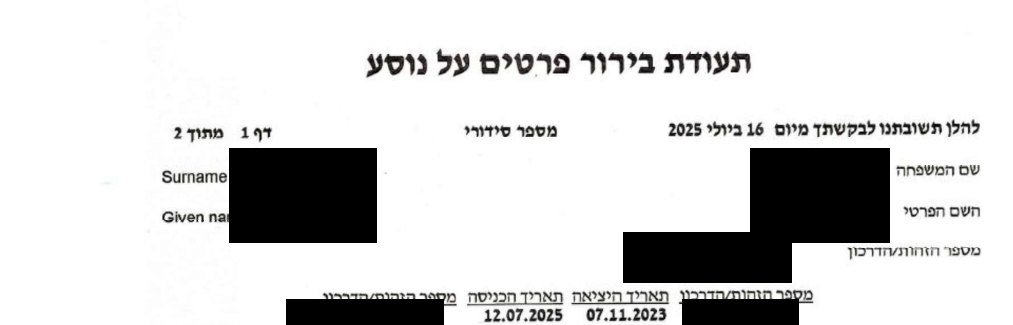
7 November 2023. A month after the war broke out, the customer left Israel. He returned on 12 July 2025. The dates appear in an official certificate of the Population and Immigration Authority.
What the bank knew, and when
- 17 April 2024, in an email to the bank: "I am not in the country and I have no intention of coming back in the near future".
- 2 May 2024, on WhatsApp to the law firm's representative: he sent a copy of his passport "so that there will be no unknown services in the file", and stated that he no longer lived at his previous address.
- 10 December 2024, a reply to a message from the law firm: "Hi. I'm abroad since November 2023".
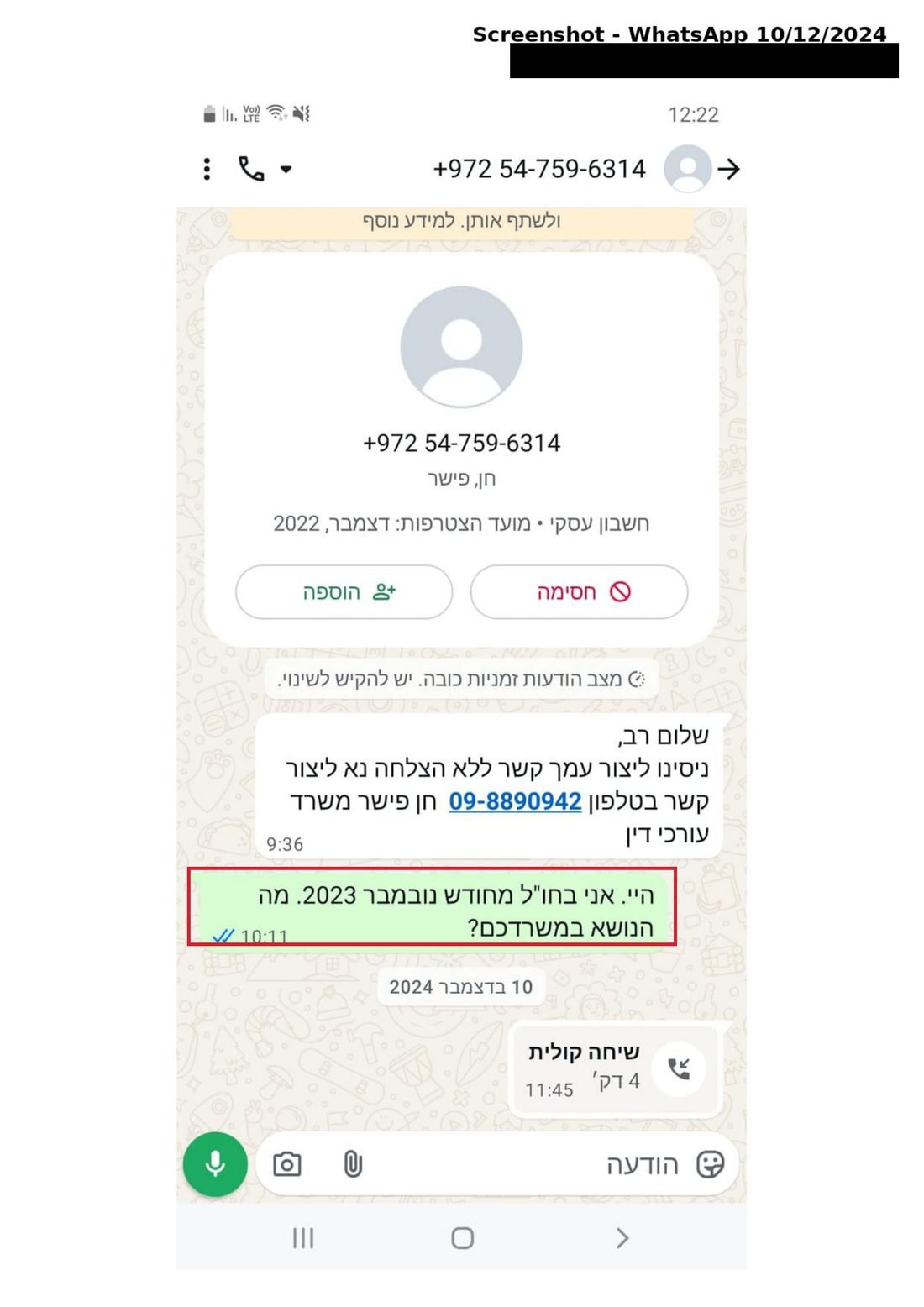
From then on, every service at the old address was carried out after the bank and its attorneys had received written notice that the customer was not there.
The first service: a letter without a street
28 February 2024. "Notice before taking proceedings".
Mizrahi Tefahot Leasing sent the customer a letter stating that the loan would be called for immediate repayment if the arrears were not paid within 21 days. The letter mentions "repeated notices that were sent to you".
The recipient's address has a name, a house number, a locality and a postal code. There is no street name.
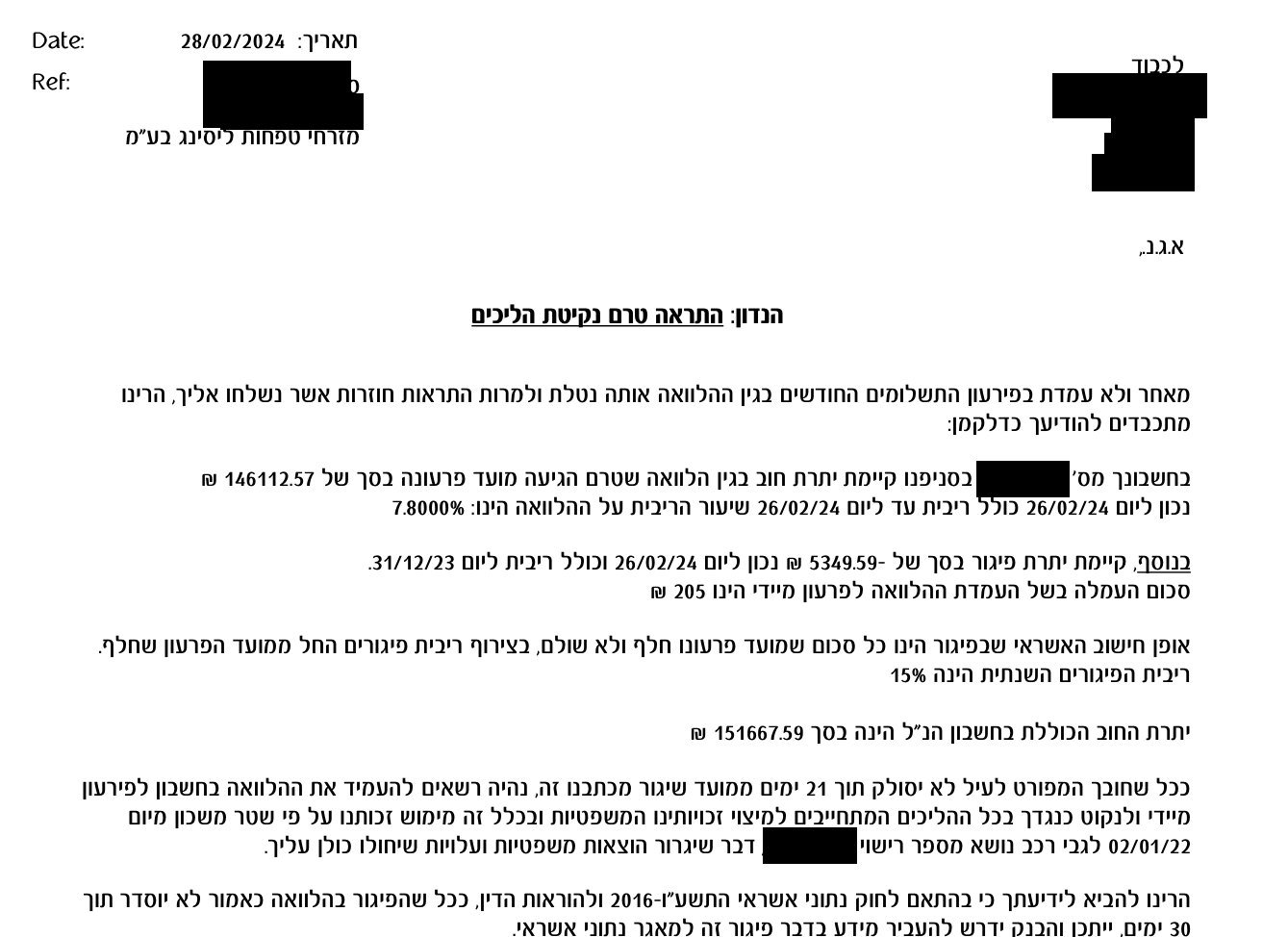
The customer had by then been abroad for four months. The file contains no postal confirmation, no record of dispatch and no confirmation of delivery of the letter. The "repeated notices" were not found either: the leasing company's log records only text messages and unanswered calls for this period. In the affidavit on which the pledge file was opened, the creditor actually argued that under the Fair Credit Law no notice is required at all.
The second service: "met the debtor" while he was abroad
22 December 2024. Summons in the promissory notes file.
On 15 December 2024, five days after he wrote that he was abroad, a promissory notes file for NIS 178,075 was opened against the customer. A week later, a report from a process serving company was filed:
"First we investigated at the address provided by your office ... and during his visit he met the debtor. The aforesaid received the documents and refused to sign the confirmation of service"
The address was "provided by your office": the law firm gave the process server the address at which the customer had told it in writing he did not live.
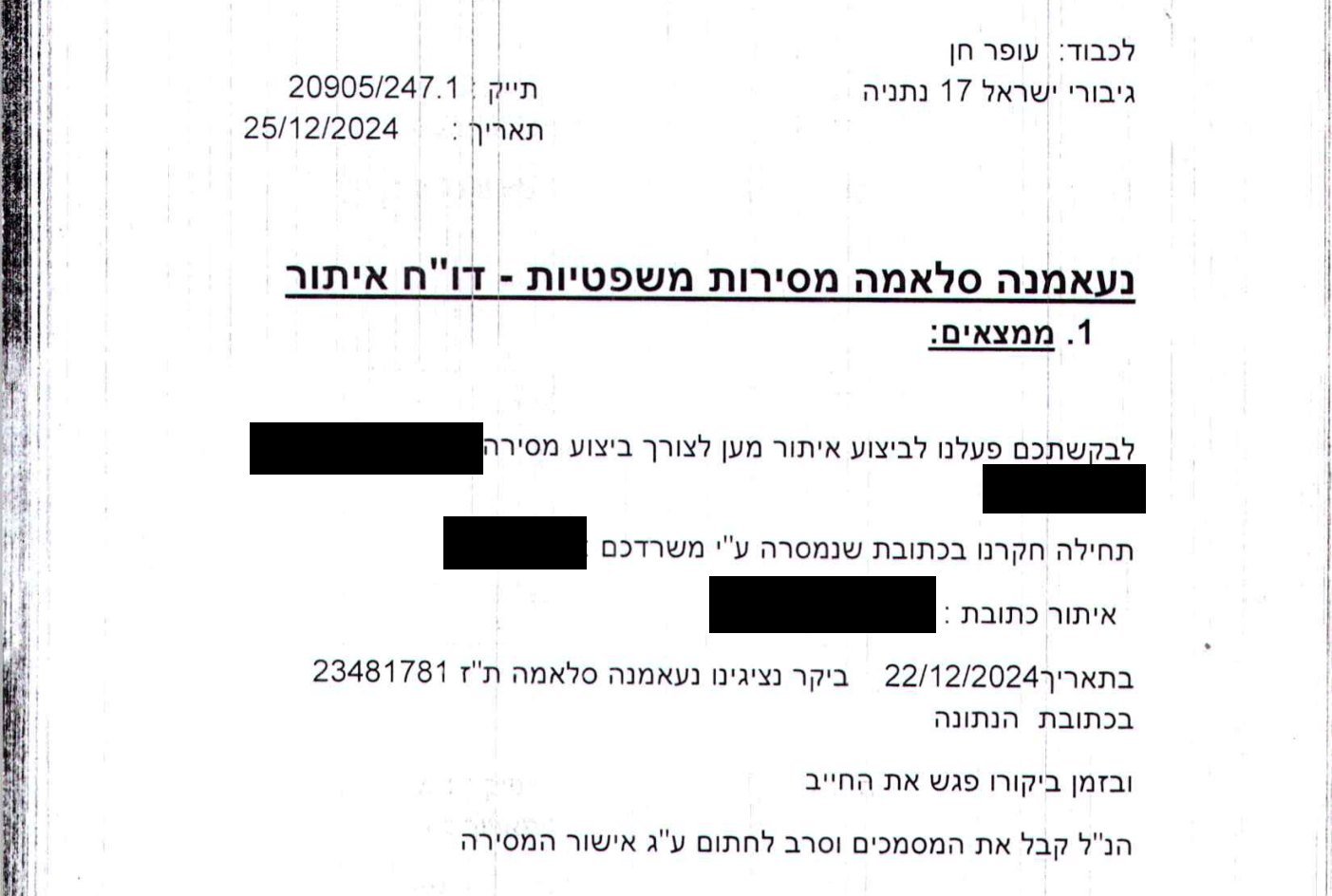
In the process server's affidavit, "served but refused to sign" was marked. In the section where the process server states how he verified the address, "through neighbors" was marked, and a neighbor's name was handwritten. According to the customer, no neighbor by that name exists.
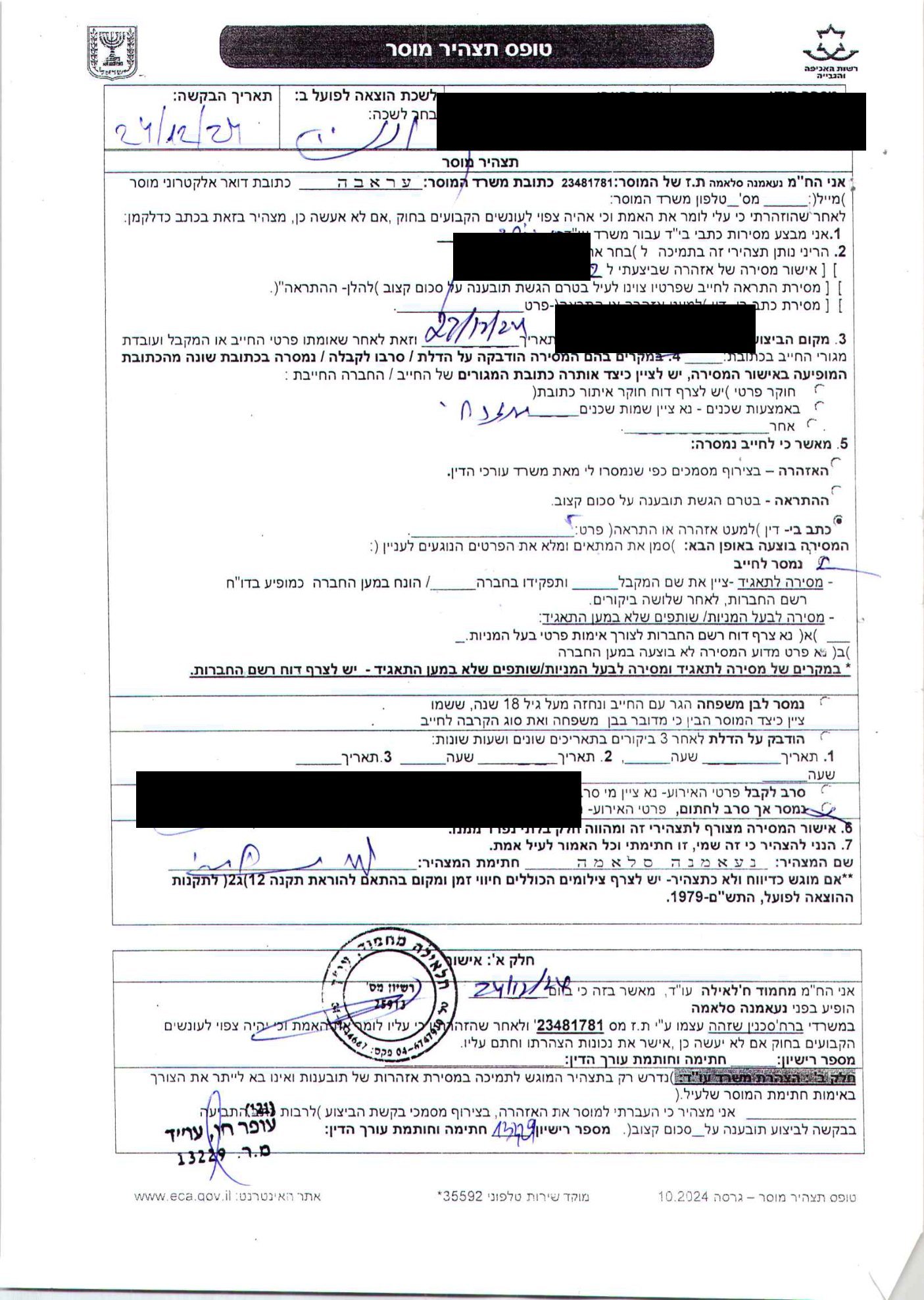
On the basis of this "service", every collection tool was opened: 33 attachments, enforcement of an attachment at the National Insurance Institute, orders to hand over information from the Population Registry and the Land Registry, and five restrictions, among them an exit ban.
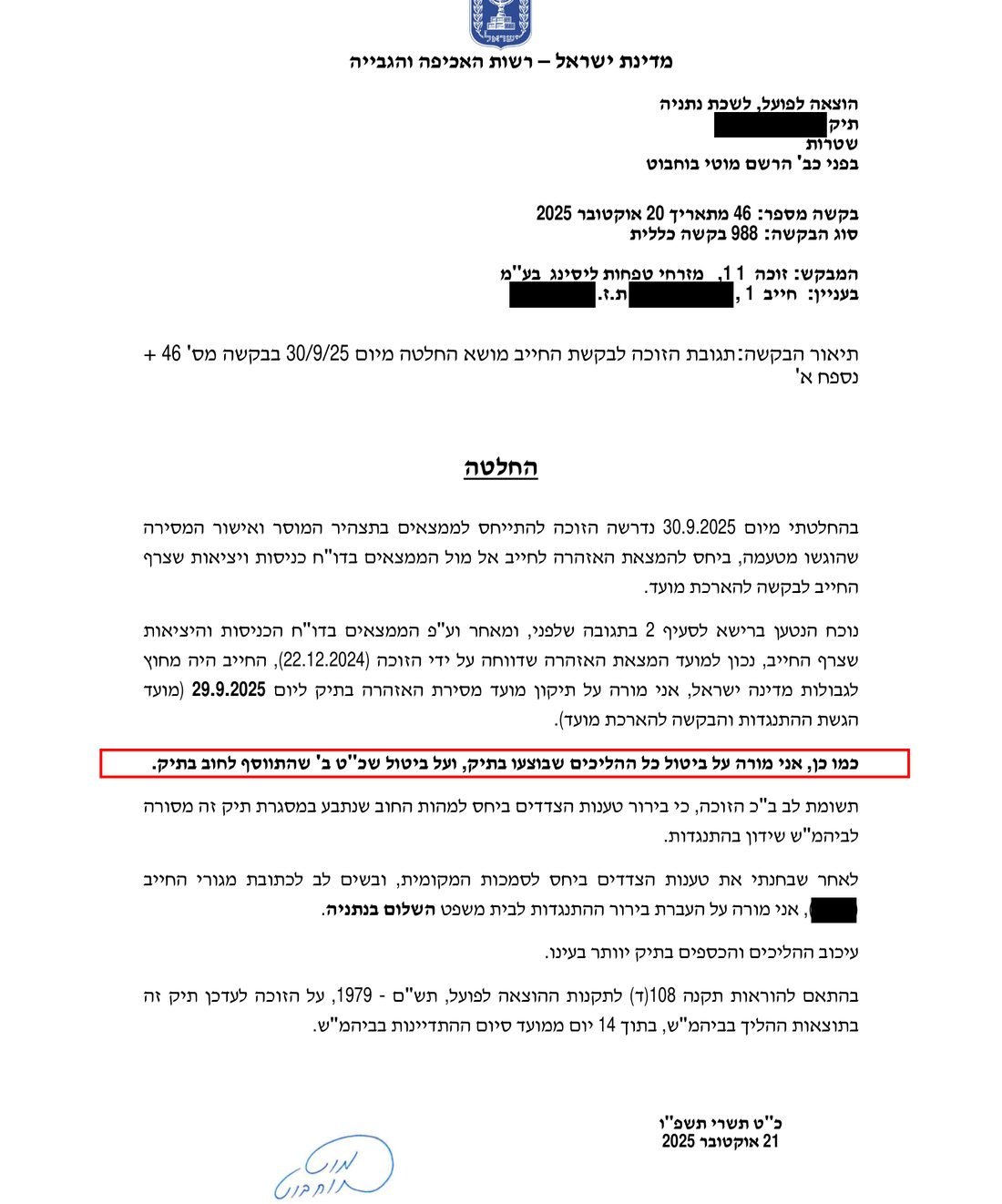
21 October 2025. The Execution Office registrar examined the matter and ruled:
"As of the date of service of the summons reported by the creditor (22.12.2024), the debtor was outside the borders of State Israel"
The registrar ordered "the cancellation of all the proceedings carried out in the file, and the cancellation of legal fee B that was added to the debt in the file".
The third service: the same process server, the same words
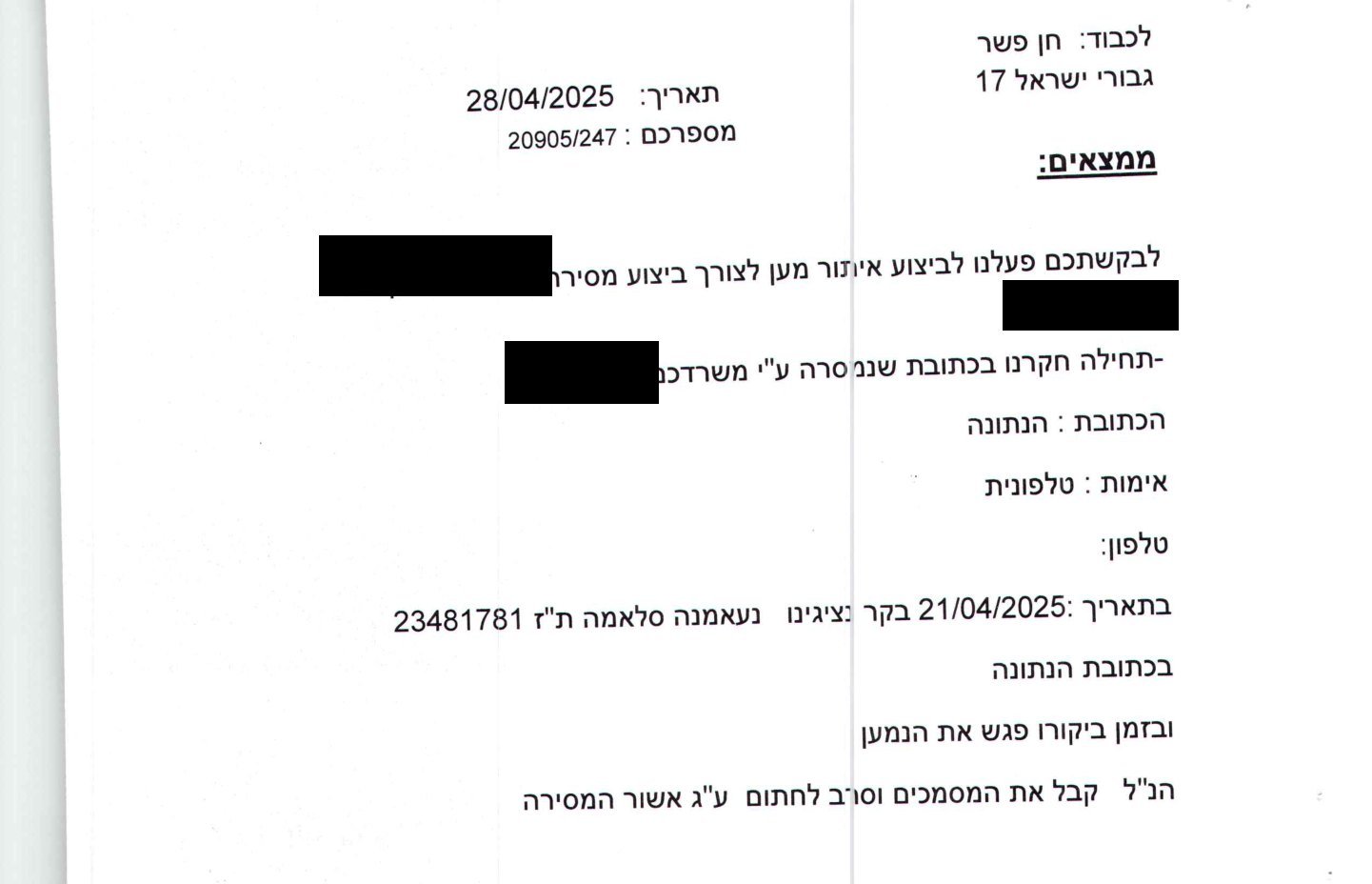
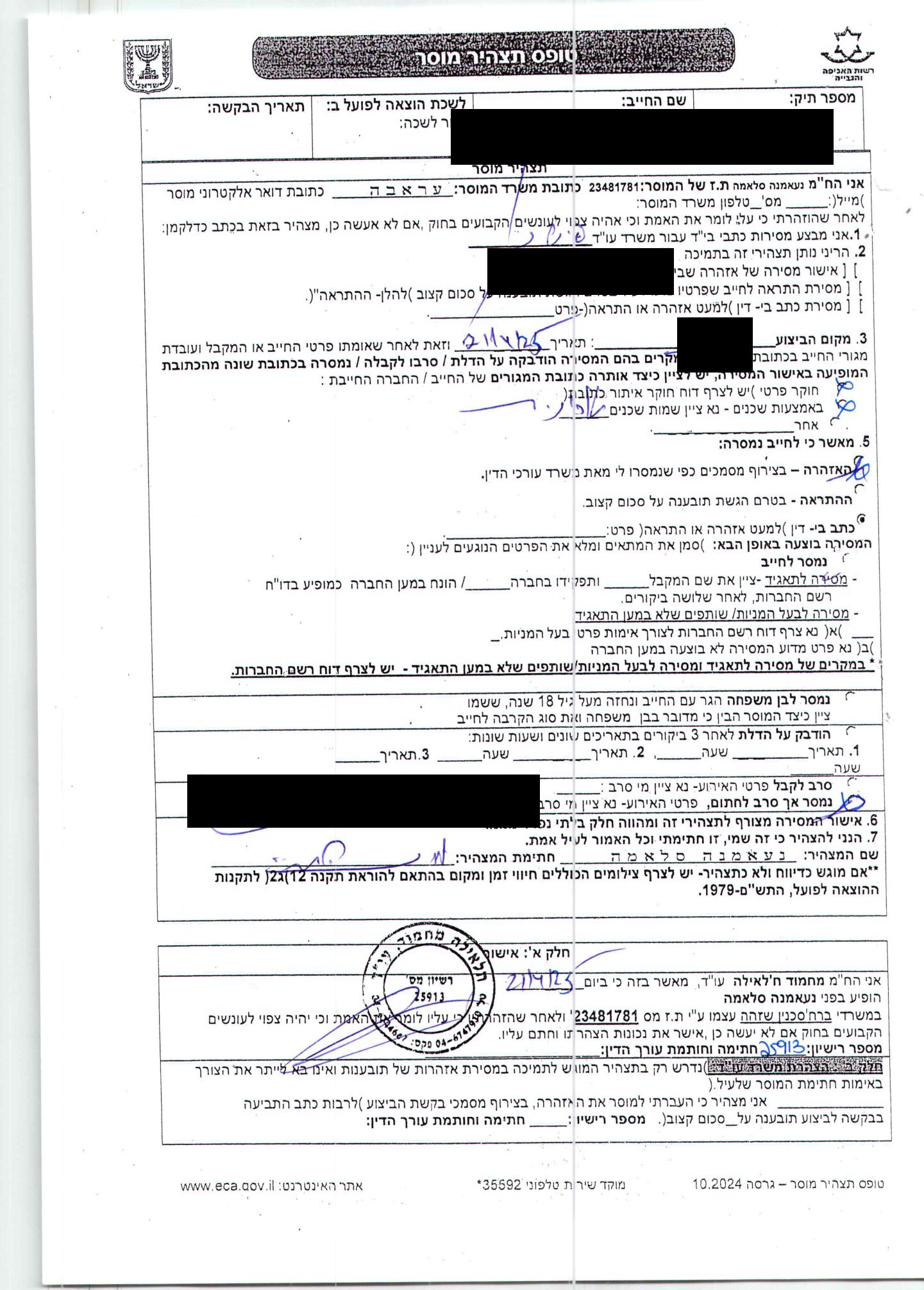
21 April 2025. Summons in the pledge file.
Four months later, in the second file over the same loan, the scenario repeated itself. The same process server, the same address, the same wording:
"First we investigated at the address provided by your office ... Verification: by telephone ... and during his visit he met the recipient. The aforesaid received the documents and refused to sign"
"Verification: by telephone", meaning the address was verified by phone. It is not clear with whom: according to the customer, his Israeli line was blocked for calls throughout his stay abroad.
13 January 2026. The Execution Office registrar ruled:
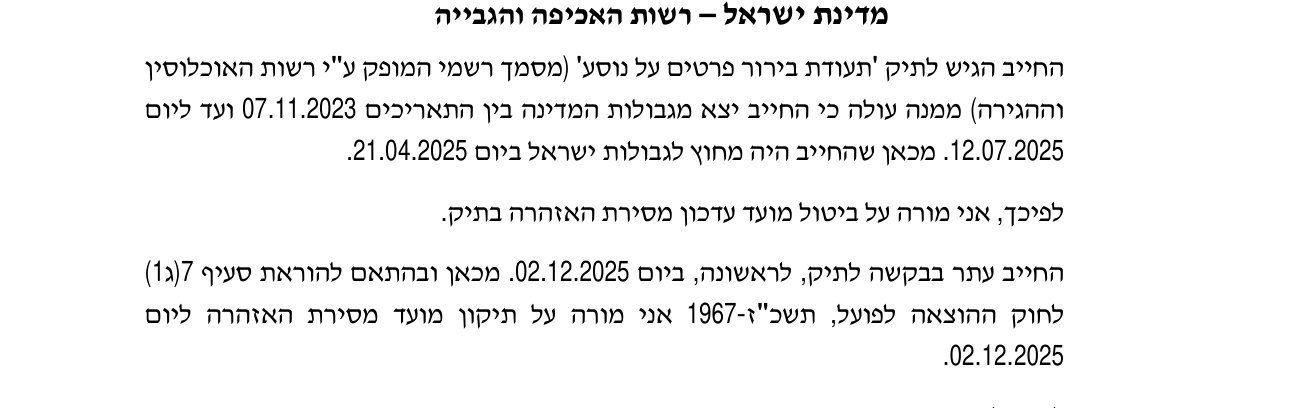
Two "personal services", two files, the same process server, and two official decisions that the customer was not in the country.
The fourth service: the bank strikes out an address and writes another
31 August to 27 October 2025. "Notice before filing for execution of a claim for a liquidated sum", a file of Mizrahi Tefahot Bank.
This time the service was the bank's own, over a current account. The customer had already returned to Israel, and was in active proceedings against the Mizrahi Tefahot group.
The confirmation of service form was printed from an internal bank system on 31 August 2025. What appears on it:
- The customer's mobile phone number, printed on the form itself (redacted).
- The printed address was struck out, and above it the old address was handwritten, the one at which the customer had stated he did not live.
- Three visits: 22, 24 and 27 October 2025. Marked: "Since no person was found at home on the third visit, I affixed the letter to the door of his apartment".
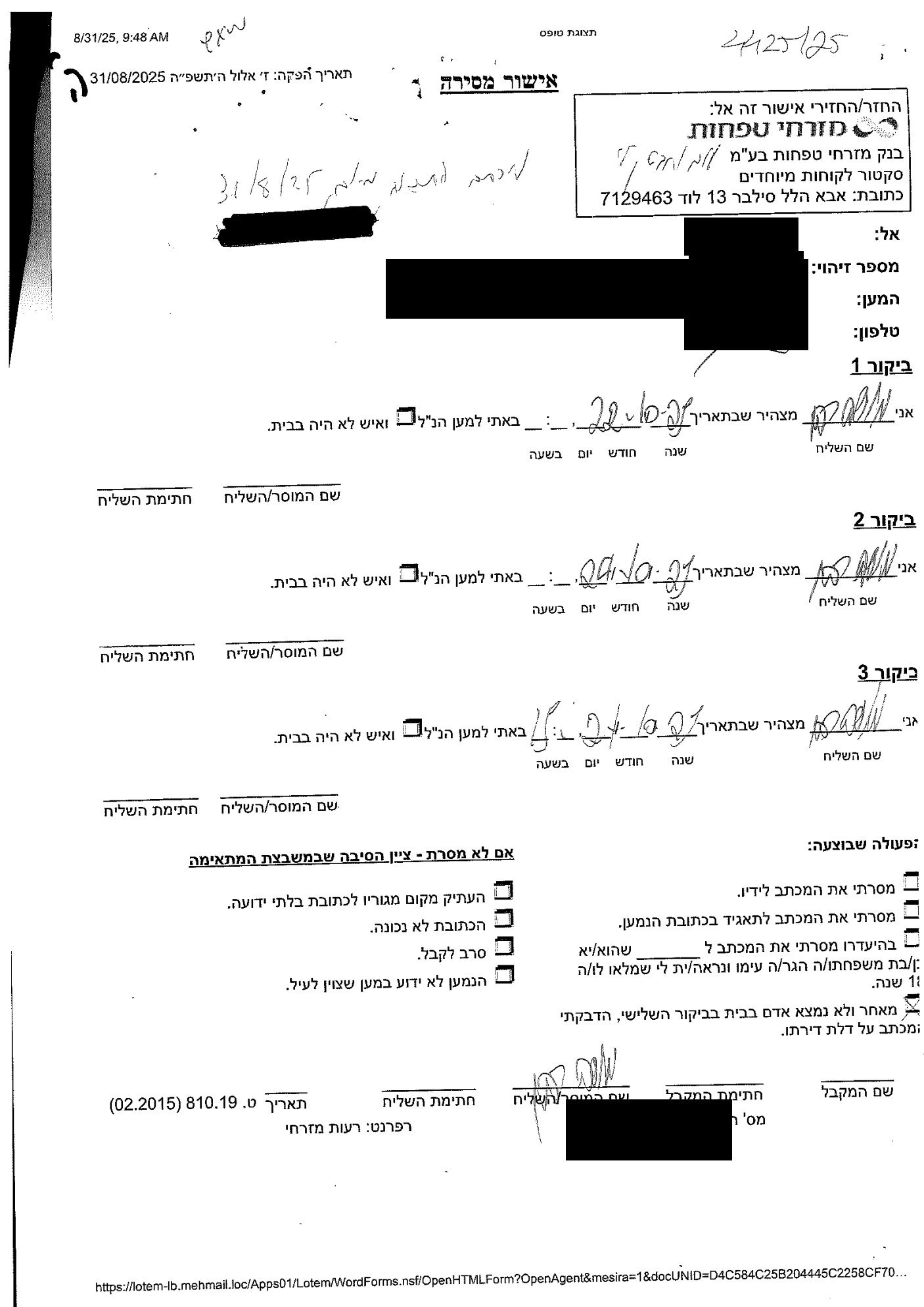
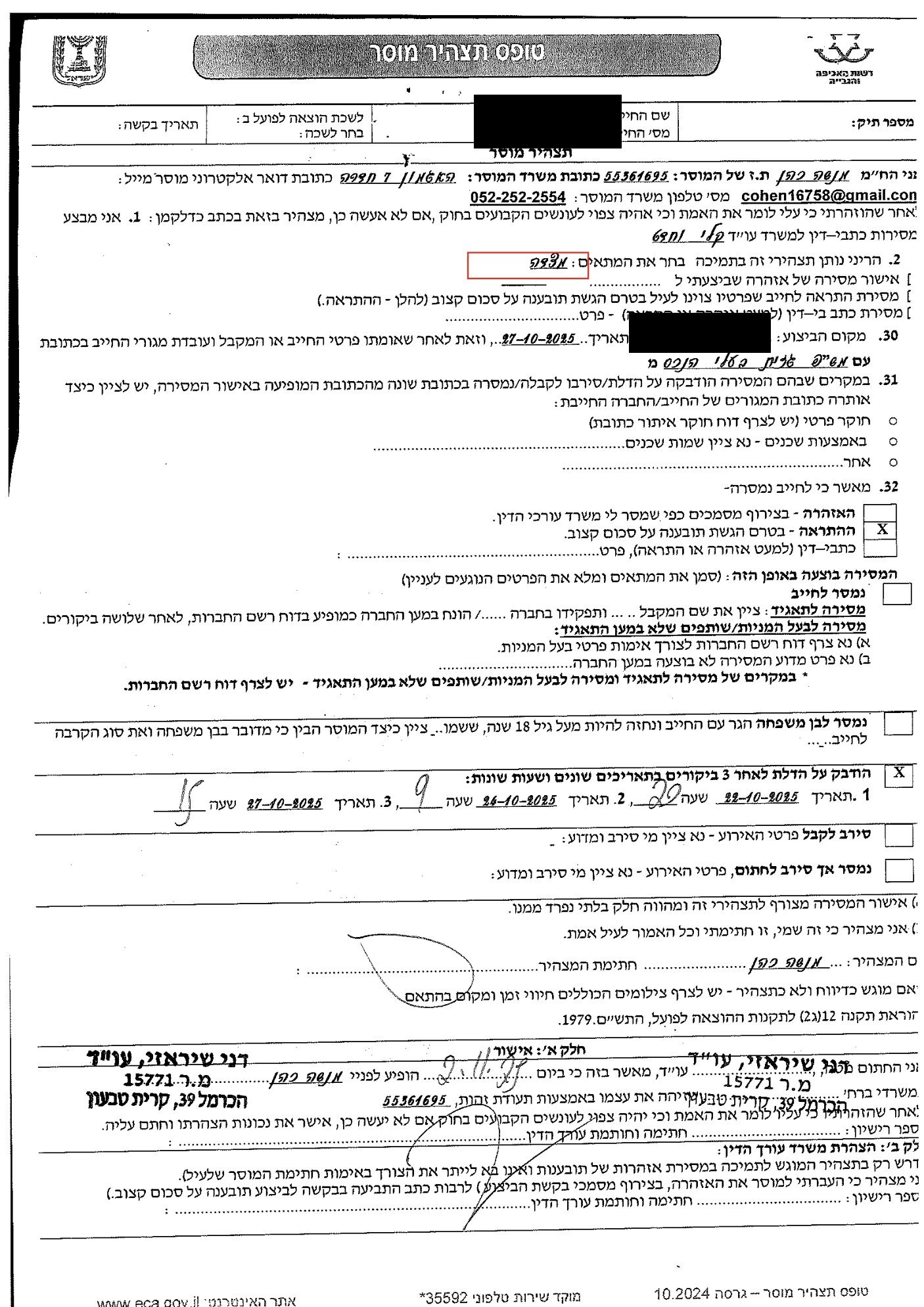
The bank held his phone number, but did not call. According to the customer, this notice should have been sent by registered mail, and it was not sent that way and did not reach him by any means. When he called the process server's number listed in the affidavit, the person who answered denied that this was his name and denied that he deals in services.
The fifth service: "served on the debtor" and also "affixed to the door"
2 to 7 December 2025. Summons to a means examination, the pledge file.
On 1 December 2025 the registrar decided to summon the customer to a means examination. A process server on behalf of the law firm visited the old address three times:
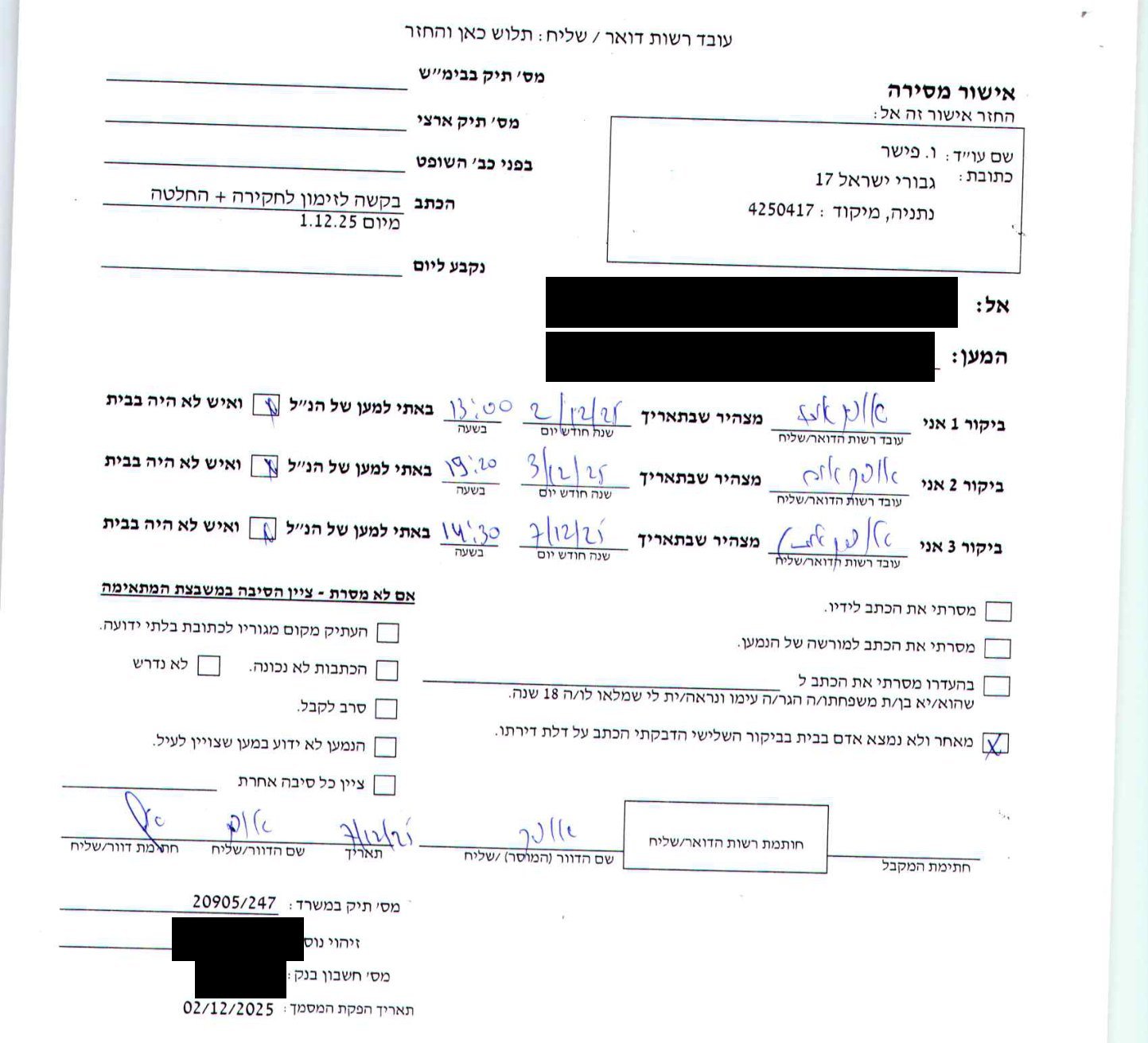
In the process server's affidavit, in the section "The service was carried out as follows", two contradictory options were marked: "served on the debtor" and also "affixed to the door after 3 visits".
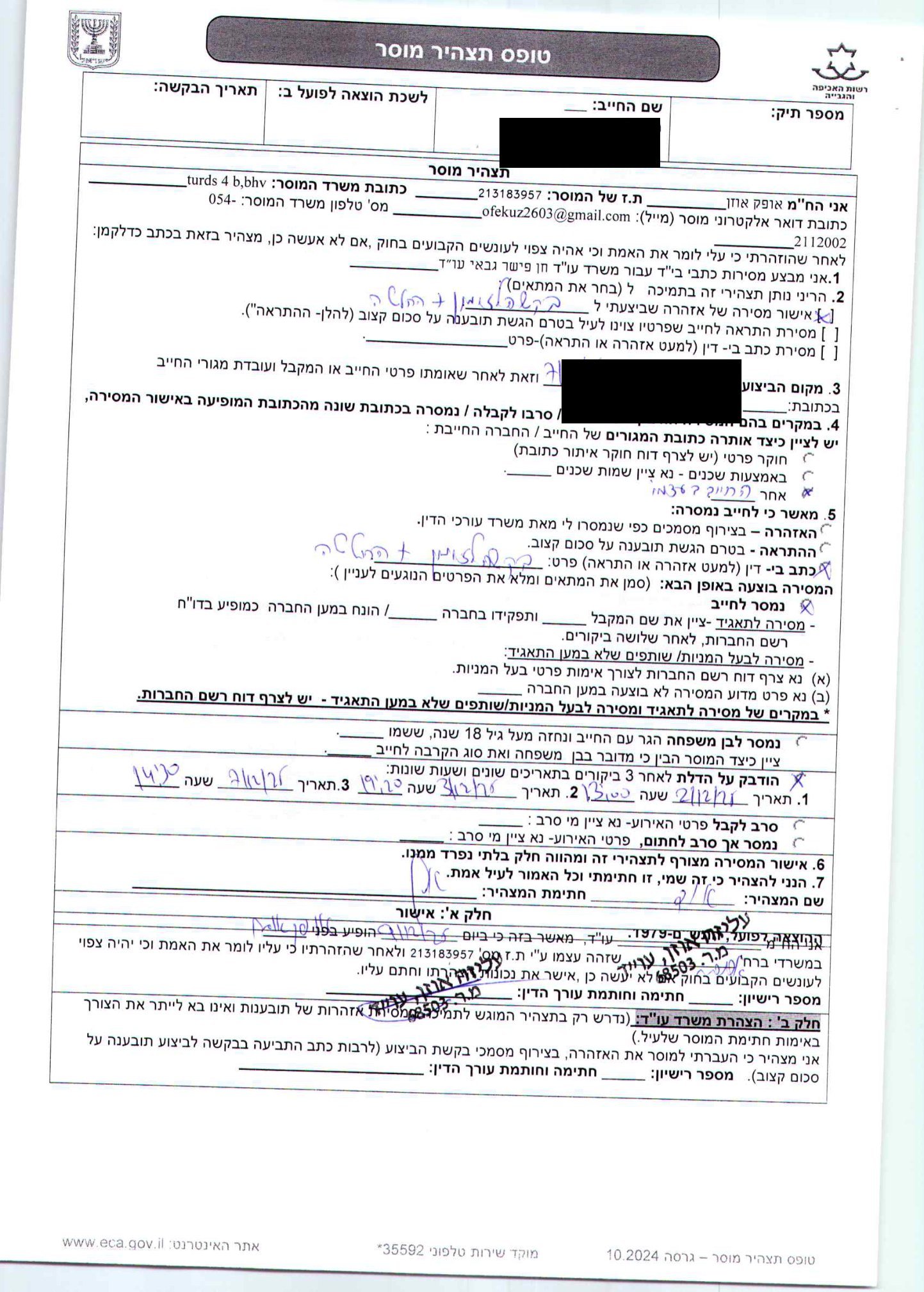
On the day of the first visit, 2 December 2025, the customer himself filed an application in the same file. The Execution Office, the creditor and its attorney knew that he was active in the file and could be reached. According to the customer, his address in Netanya was already in their hands. On the day of the third visit and the affixing, 7 December 2025, his new address was also registered in the Population Registry:

On the basis of the affixing, the creditor's attorney requested a bring-in order: "The debtor did not act in accordance with the decision ... the confirmation of service is attached". On 21 December 2025 the registrar ordered a bring-in order, "in view of ... the attachment of proof of service of the decision ... on the debtor". Three days later his address in Netanya was updated in the file, and in January 2026 the order was cancelled.
The sixth service: "refused to sign", and the details field is empty
23 April 2026. Summons in a file of Mizrahi Tefahot Bank.
Four and a half months after the customer's registered address moved to Netanya, it was reported once again that a summons had been served on him at the old address. The same process server who affixed the notice in October now declares that the customer was "served but refused to sign".
The form has a mandatory field: "Details of the event - please state who refused and why". The field is empty, just brackets.
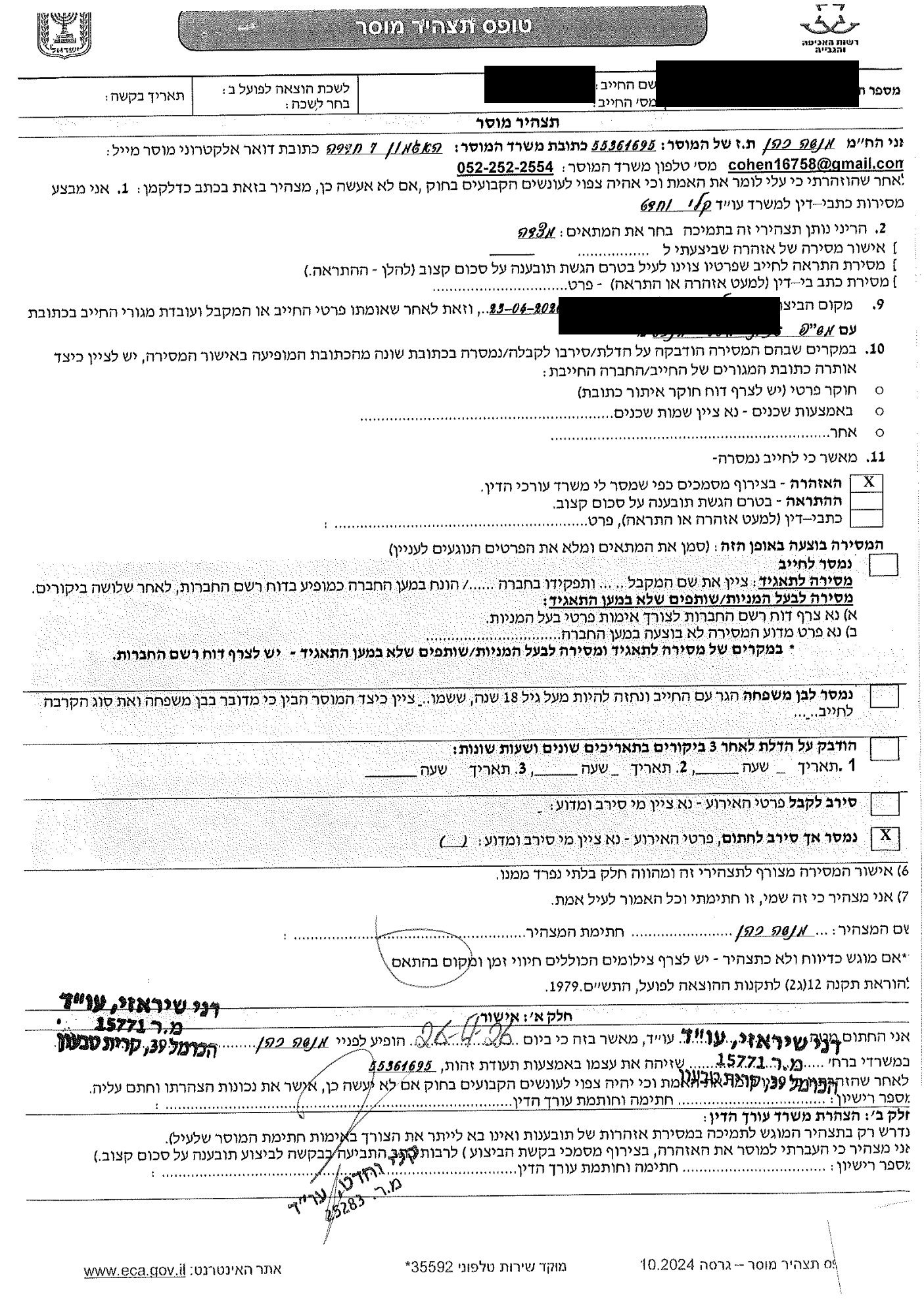
In a sworn affidavit the customer wrote: "The summons in the Execution Office file was not served on me on 23.04.2026 or at any other time. On the alleged date I was living in Netanya. I did not meet any process server, I did not refuse to receive any document and I did not refuse to sign it."
In February and March 2026, before this service, the customer corresponded directly with the bank in requests to access information. According to him, the bank replied to him and did not mention the file.
In September 2026 the bank agreed to extend the customer's deadline for filing an objection, "without admitting any claim". The objection has not yet been heard.
The pattern
| Date | What was served | Wording of the service | Where the customer was | |
|---|---|---|---|---|
| 1 | 28.02.2024 | Notice before proceedings | Letter without a street, without confirmation of dispatch | Abroad |
| 2 | 22.12.2024 | Summons, promissory notes file | "met the debtor", "refused to sign" | Abroad (registrar's finding) |
| 3 | 21.04.2025 | Summons, pledge file | "met the recipient", "refused to sign" | Abroad (registrar's finding) |
| 4 | 27.10.2025 | Notice before execution, bank's file | Printed address struck out, "affixed" | In the country, phone on the bank's form |
| 5 | 07.12.2025 | Summons to a means examination | "served on the debtor" and also "affixed" | In Netanya, had filed an application in the file |
| 6 | 23.04.2026 | Summons, bank's file | "refused to sign", details of the event empty | In Netanya (registered address) |
Three process servers, three files, two companies in the Mizrahi Tefahot group. In all five services carried out by process servers, one of two methods was chosen that do not require the recipient's signature: "refused to sign" or "affixed to the door". In every case the address was one that the customer had stated he had left, or an address that the bank itself had struck out. And in every case, the bank and its attorneys held his phone number, his email and his WhatsApp, and did not use them to notify him.
| Sewer Service in New York | In the Mizrahi Tefahot files |
|---|---|
| Service at an old address the creditor knows is wrong | An address the customer stated in writing he had left, "provided by your office" |
| "Received and refused to sign" | Three times, in three files |
| A process server "in two places at the same time" | "Met the debtor" while he was abroad, twice |
| Affixing to a door after three visits | Twice, at the old address |
| A neighbor or family member who does not exist | "Through neighbors", according to the customer a neighbor who does not exist |
| Attachments before the defendant knows | 33 attachments, an exit ban, a bring-in order |
What was ruled against the customer
For the full picture:
- The Execution Office registrar in Haifa on 13 January 2026 rejected his application to stay the proceedings in the pledge file, and ruled that he had not proven defects in the creditor's conduct.
- The Magistrates' Court in Netanya on 31 May 2026 rejected his objection in the promissory notes file. Regarding the summons, it was held that the claim "has already been decided" by the registrar, who gave him the opportunity to file an objection.
- His claims about the services in the bank's file have not yet been decided.
No registrar or judge has ruled to date that any service was made knowingly. What has been established are the facts: in the first two personal services, the customer was not in Israel.
The question
In the United States, after false affidavits of service were exposed on a large scale, people were sent to prison, law firms were sued, and a GPS requirement was imposed on every process server.
In Israel, a process server's affidavit attested before a lawyer is still the basis for an attachment, a restriction and a bring-in order. When it turns out to be untrue, the proceeding is cancelled, the date is corrected, and the file goes on.
Who is responsible when a bank, its law firm and the process servers they hire report to the state that documents were served on a person they know is not there?
About this article: The article is based on the documents of the Execution Office files (confirmations of service, process servers' affidavits, locator reports, registrar decisions), the certificate of the Population and Immigration Authority, an extract from the Population Registry, and the customer's correspondence with the bank and with the law firm. The American background is based on the New York bar report "Out of Service" (2010), the judgment in Sykes v. Mel S. Harris (federal court of appeals, 2015), the announcements of the Attorney General of New York State (2009 to 2010) and the New York Focus investigation (2025). What is attributed to the customer is his account. Quotations are given verbatim, including the term "the debtor". File numbers and the customer's identifying details have been redacted in the documents, including where they were handwritten. The article was written with the assistance of artificial intelligence on the basis of the documents, and was reviewed and approved by the customer. This English version is an AI-assisted translation of the original Hebrew article; the quotations were translated from Hebrew. The Hebrew version is the controlling text.