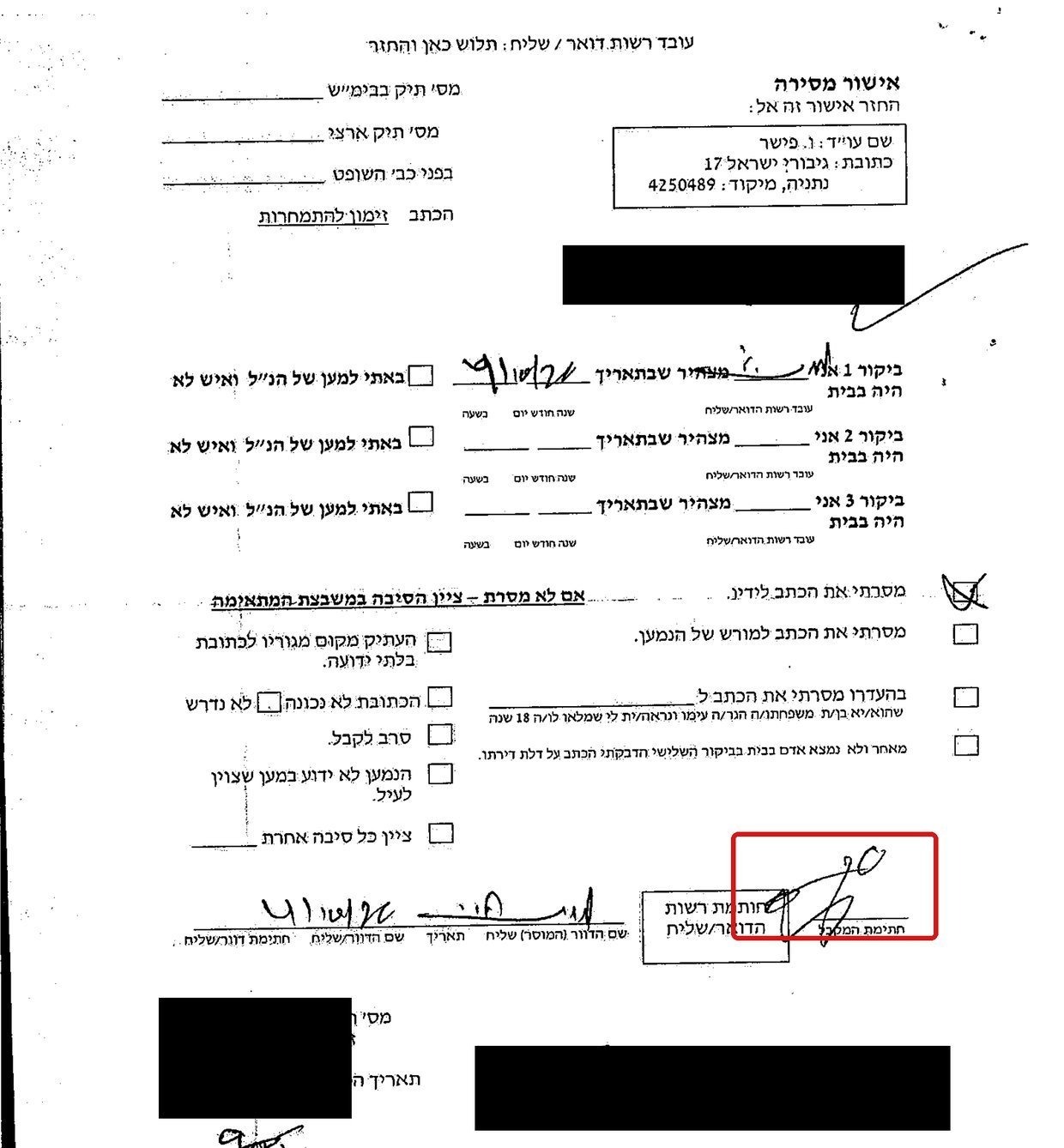
On 21 October 2026 lawyer Victor Fisher, the receiver in the Mizrahi Tefahot Leasing pledge file, signed an affidavit: "I confirm that all the details set out in the attached report were checked and, to the best of my knowledge and understanding, are correct".
The application he filed with the enforcement registrar that day gave, next to the buyer's name, an ID number that is not his. According to the Population Registry, it is his daughter's ID number.
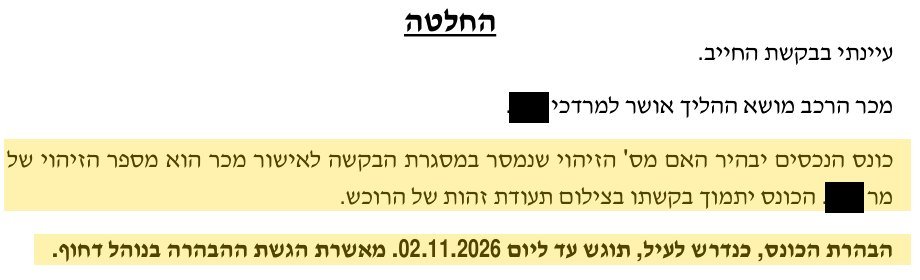
On 29 October 2026 the registrar ordered the receiver to clarify whose number it is, and to attach a copy of the buyer's ID card.
In brief
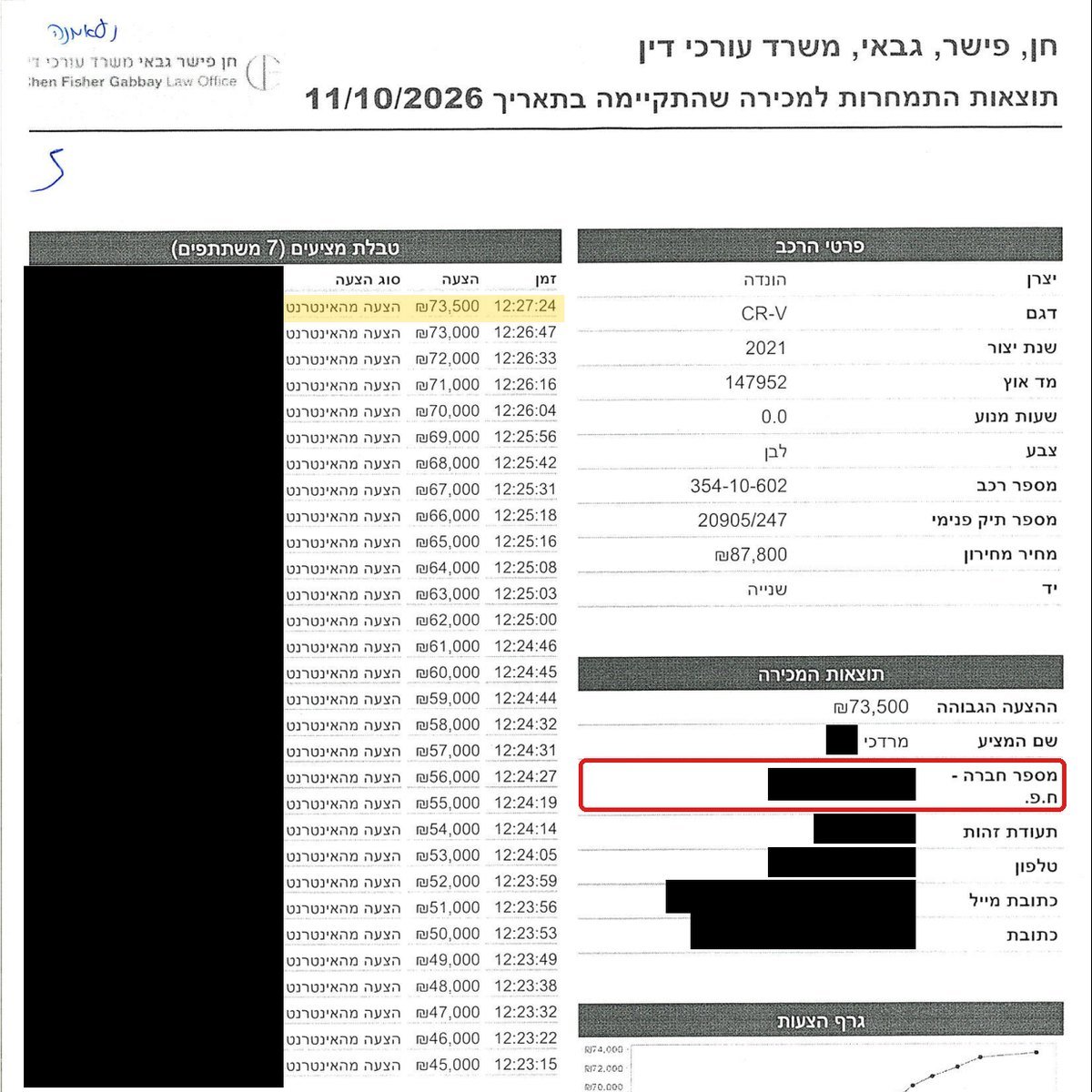
- 11.10.2026: a public auction of the car, seven bidders. A car dealer named Mordechai placed one bid, the last one, of 73,500 shekels, and won.
- In the auction record: next to the dealer's name a number was entered in the field "company number". According to the Population Registry, it is his daughter's ID number.
- 21.10.2026: the receiver applied for approval of the sale and wrote the daughter's number next to the father's name three times. His affidavit was attached.
- The car owner did not know about the auction. According to him, his signature on the auction summons was forged, and that same day he received a call in which he was asked for his address.
- 29.10.2026: the registrar ordered the receiver to clarify and to provide a copy of the buyer's ID card by 2.11.2026.
The affidavit: testimony in writing
An affidavit is not a letter. Whoever signs it declares that he was warned to tell the truth and that he will be liable to the penalties prescribed by law if he does not. An affidavit filed with a judicial body is testimony.
This is how Mr Fisher's affidavit opens: "I, the undersigned, lawyer Victor Fisher ... having been warned that I must tell the truth and that I will be liable to the penalties prescribed by law if I do not, hereby declare in writing as follows".
And in section 2: "I confirm that all the details set out in the attached report were checked and, to the best of my knowledge and understanding, are correct".
The affidavit was certified on 21.10.2026 before lawyer Ofer Chen, one of the creditor's counsel in the file.
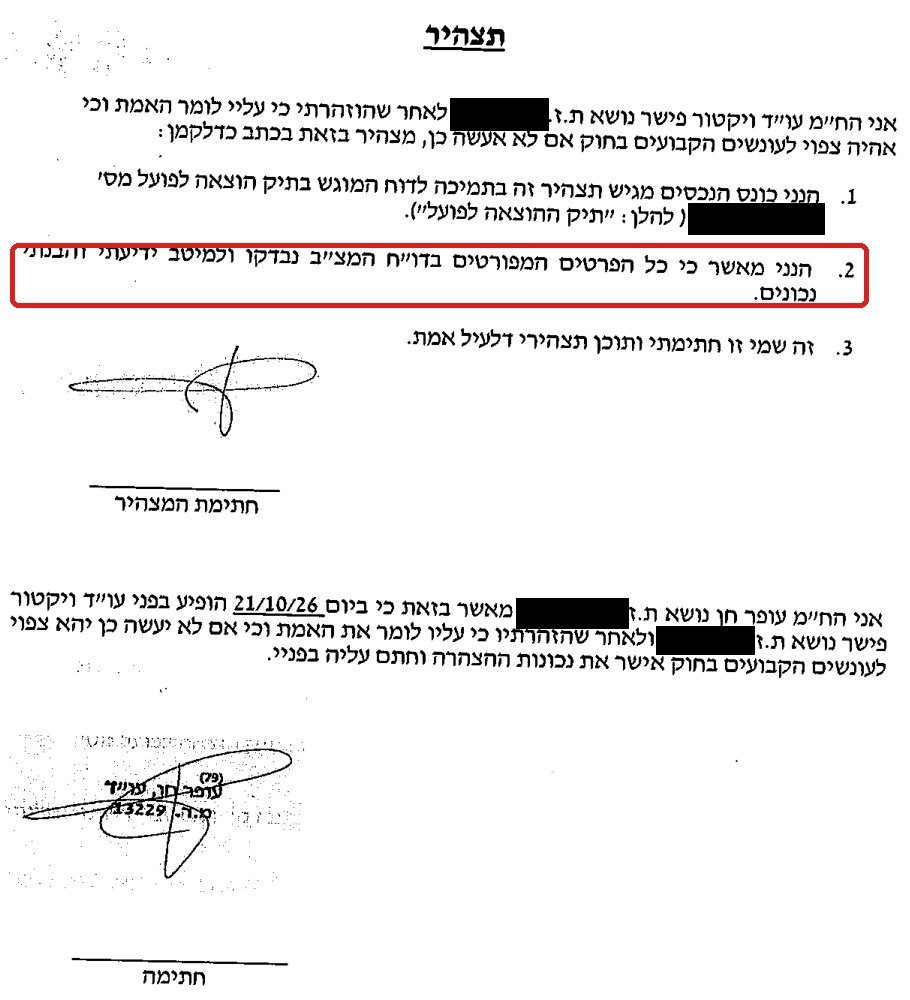
What the receiver wrote in the application
Section 8 of the sale application, signed by Mr Fisher, reads: "In light of the above, it is requested to approve the sale of the car to Mr Mordechai [surname blacked out], ID [number blacked out], free of any pledge, attachment or third-party right".
The same number appears three times in the application: in the opening, in section 4 and in section 8. The daughter's name does not appear in it at all.
According to a Population Registry reply of 28.10.2026, the number belongs to the dealer's daughter. She did not take part in the auction, is not among the seven bidders in the record, and did not sign the sale agreement.
What the receiver had in hand
Two documents filed by the receiver himself show that the dealer's correct number was known.
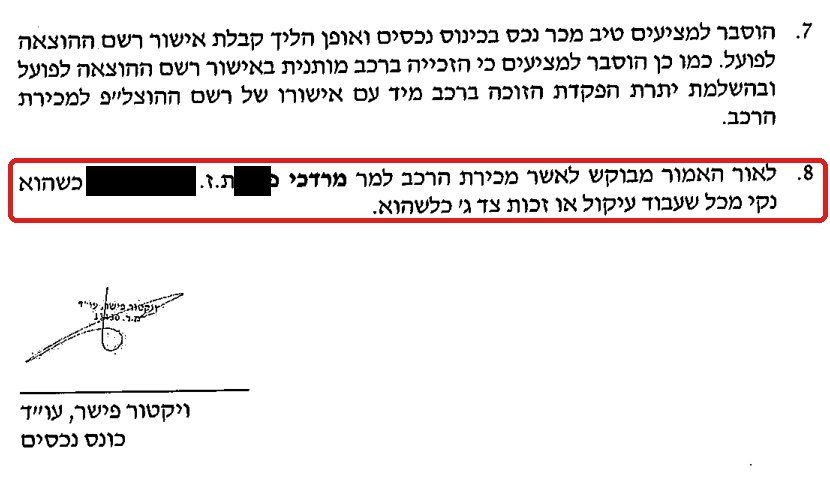
The sale agreement
On 11.10.2026 a sale agreement was signed between "Fisher Victor, in his capacity as receiver" and the buyer, Mordechai. In the buyer's "ID" field, his own ID number is recorded, not his daughter's.
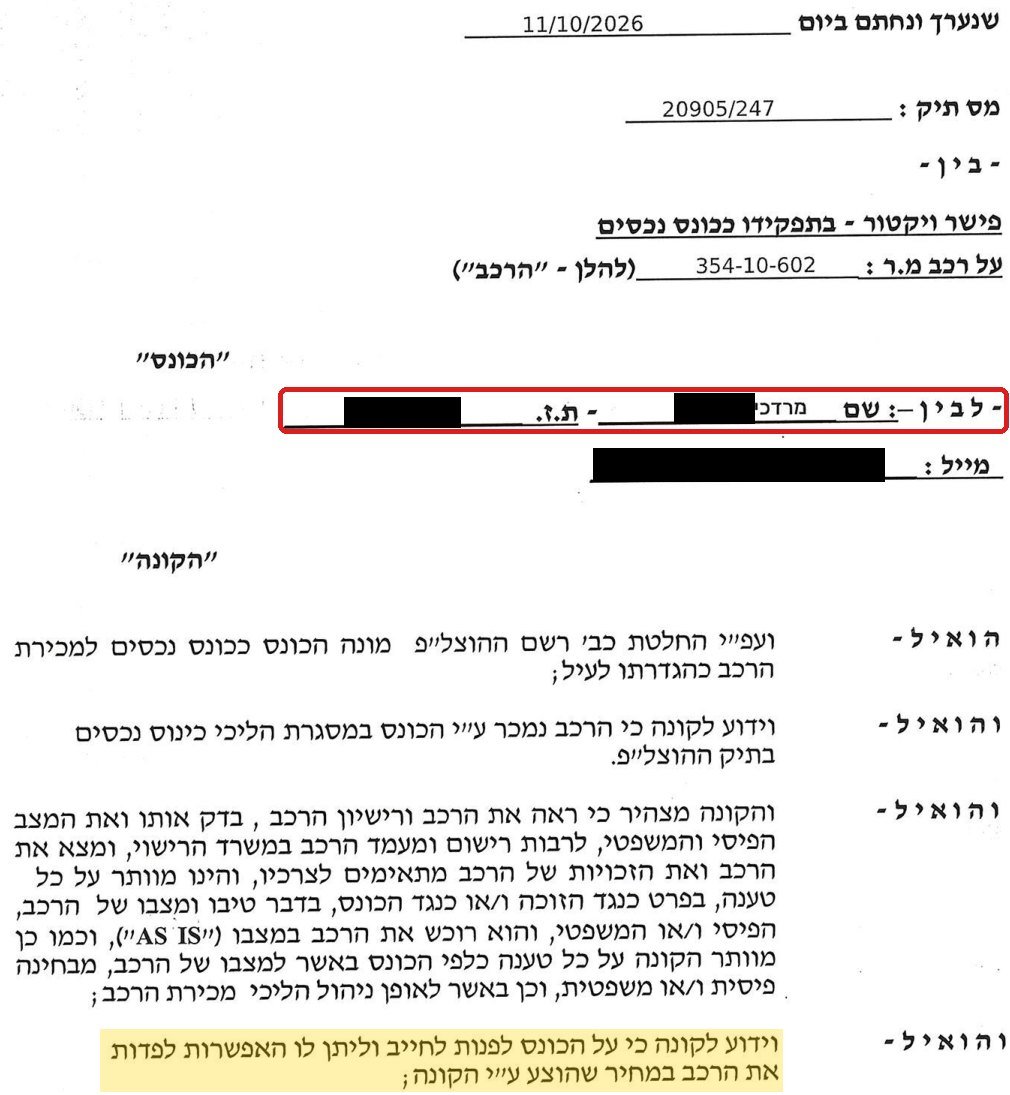
The auction record
The sheet "Results of the auction held on 11/10/2026" from the Chen Fisher Gabbay office shows two numbers next to the winner's name. His ID number is in the field "ID". The daughter's number is in the field "company number".
The dealer has no company with that number. His business number at the Tax Authority is his own ID number.
Alongside the auction, the receiver's office published: "No change of the winner's name after winning the tender!". Whoever won is the one who should be registered as owner.
The auction
The auction opened on 11.10.2026 on the receiver's office website. According to the record, the first bid, 45,000 shekels, came in at 12:23:15. In under four minutes the bids rose a thousand shekels at a time, up to 73,000 shekels at 12:26:47.
At 12:27:24 Mordechai placed one bid: 73,500 shekels. It was his only bid in the whole auction, and it won.
The car details table in the record lists a "price list value" of 87,800 shekels. The appraisal attached to the application, after deductions, set a value of 37,486 shekels.
Why a dealer pays 73,500 shekels
Section 1 of the sale agreement says: "As consideration for the car the buyer shall pay the receiver the sum of 73,500 ₪ including VAT".

According to a Tax Authority certificate of 28.10.2026, the buyer is registered as a business, and his VAT branch is "trade and brokerage of used motor vehicles".
In Interpretation Directive 1/2020 the Israel Tax Authority set out how a used car "purchase and sale" transaction is handled: the dealer buys the car and signs a purchase agreement, and when he sells it he must "issue an invoice to the buyer". It also states: "a dealer must keep the trade book ... in which the required details are recorded for each vehicle separately".
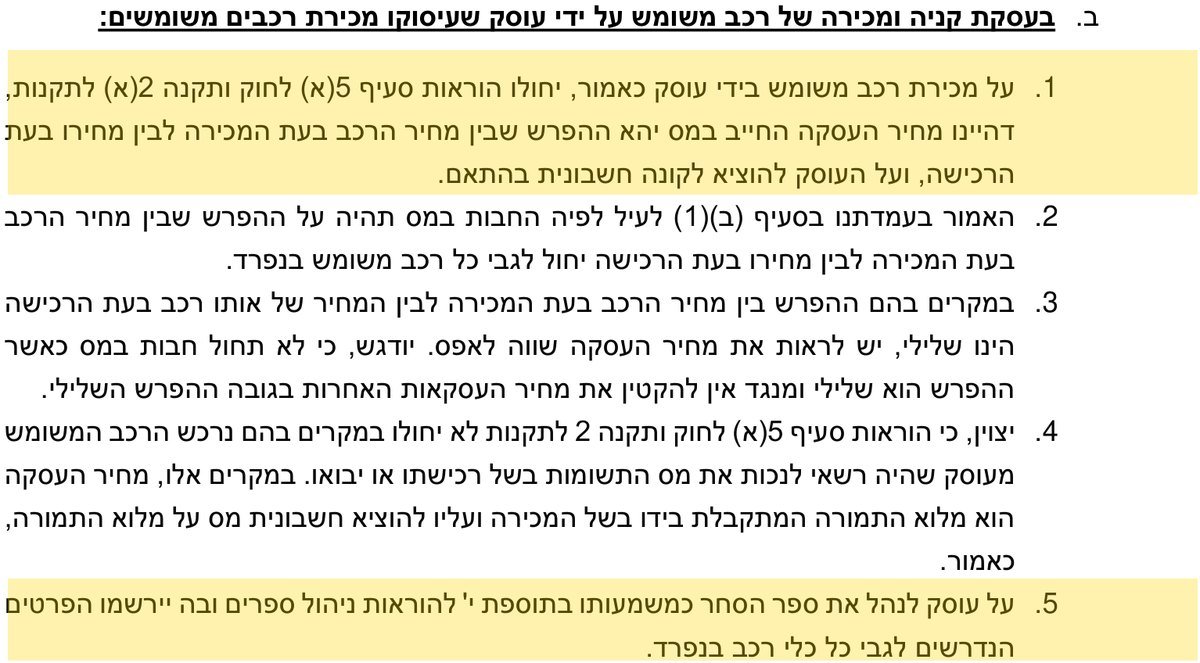
According to the car owner's suspicion, this is how it works: on the purchase, the dealer books the expense and offsets the VAT. If the car is registered in the daughter's name, his next sale can look like a private deal: no invoice, no VAT on the profit and no entry in the trade book. The daughter owes nothing, because she is not a business. And the dealer owes nothing, because the car is not in his name.
We have no evidence of a motive, and we do not know what the receiver knew. That is exactly the question the registrar put to him.
The summons that never arrived
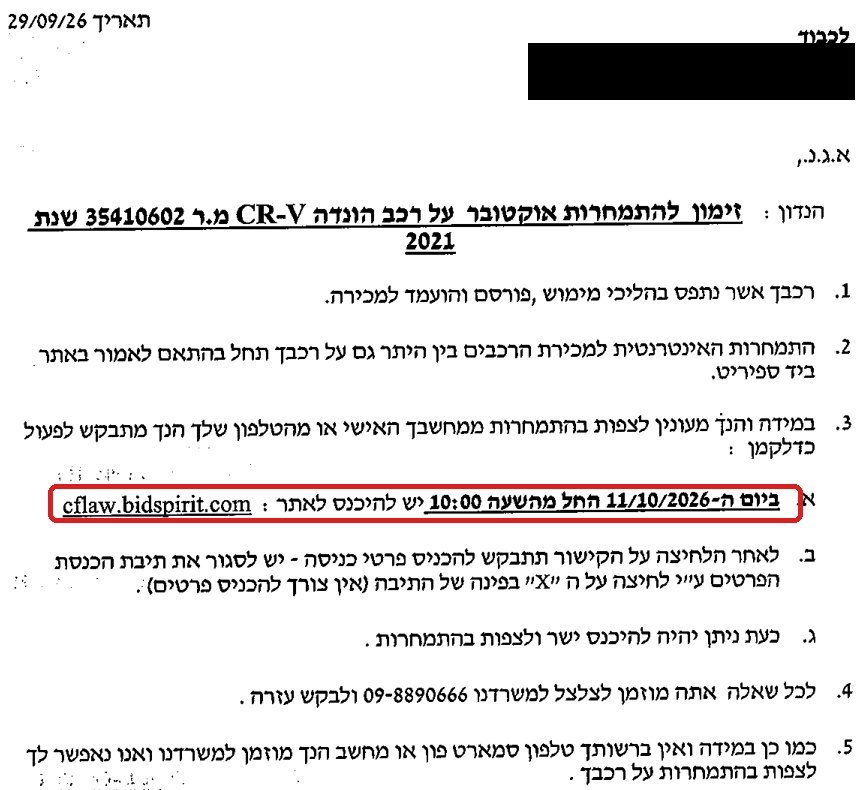
On 29.09.2026 the receiver's office sent the car owner an "auction summons". The letter said that if he wished to watch the auction he should log in "on 11/10/2026 from 10:00" to the office's auction website.
According to the locate report of the process server Naamna Salama, on 4.10.2026 he "met the addressee", and the car owner "received the documents and signed the proof of service". The time of service appears neither in the report nor in the server's affidavit. According to the car owner's account and affidavit, he met no one, and the signature in the "recipient's signature" field is not his.
The call
That same day, at 11:35, the car owner received a 46-second incoming call from 052-3720813. The number is saved in his phone as "Chen Fisher Gabbay courier". We published the call log in the article Mizrahi Tefahot - The Parade of Forgeries.
The call was recorded. The recording, 33 seconds long, started when the call was already under way. This is the transcript, without the address:
Caller: "...that I'm sending you, your address is [address omitted]?"
Car owner: "Where are you calling from?"
Caller: "Mizrahi Tefahot Leasing, financing."
Car owner: "Yes?"
Caller: "Yes, so your address is [address omitted]?"
Car owner: "Why do you need an address? ... The address, first of all, is correct, right, but..."
Caller: "Great, that's it, that's it, so I'm sending the letter to that address, thank you very much. Bye."
Someone standing in front of a person and handing him a document does not ask him on the phone for his address, and does not tell him "I'm sending you the letter". According to the car owner, that was the only contact with him that day: a phone call. And after it, a proof of service with a signature that attests to a meeting.
Not the first time
The same process server had already reported personal service on the car owner twice, and both times enforcement registrars found that on that day he was outside Israel. The creditor itself wrote in October 2025: "it cannot be ruled out that he had another person sign who identified himself to him as the debtor". The details are in the article Sewer Service ISRAEL.
The redemption letter
On 12.10.2026, the day after the auction, the receiver wrote to the car owner a "redemption notice". It said that the highest bid was 73,500 shekels, that the car had been appraised at 37,486 shekels, and "therefore you are given an extension to redeem the car in accordance with the law". The car owner was given 7 days "from receipt of this letter" to bring his own appraisal.
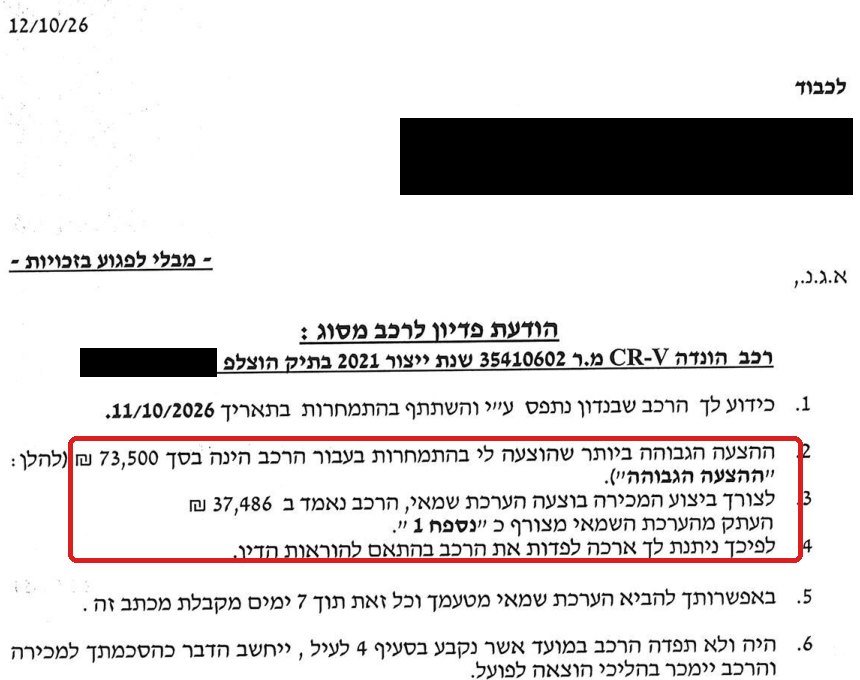
The sale agreement contains the same undertaking: "the buyer is aware that the receiver must approach the debtor and give him the opportunity to redeem the car at the price offered by the buyer".
According to the receiver, the letter was delivered on 18.10.2026 and the car owner "received the documents and refused to sign". In the server's affidavit only "delivered to the debtor" was ticked, and the proof of service has an entry in the "recipient's signature" field. The car owner says he did not receive this letter either.
One more thing: if the letter was delivered on 18.10, the seven days ended on 25.10 at the earliest. The sale application and the affidavit were signed on 21.10. Section 6 of the application says: "despite the expiry of the date set in the notice, no objection of his was received".
Why was the car owner kept out?
This is the question the car owner is asking. We do not have the answer, but the documents show what could have happened had he known:
- He could have watched the auction, and seen that the winner placed one bid, in the last minute.
- He could have redeemed the car at the winning price, or brought his own appraisal, as the redemption letter itself allows.
- He could have objected to the application before it was approved, and pointed to the ID number written next to the buyer's name.
None of this happened. On 28.10.2026 the sale was approved, and the decision says it was approved "in the absence of an objection by the debtor". According to the car owner's suspicion, someone who does not know about the sale does not ask questions either.
According to the car owner, a police complaint has been filed.
The decision of 29 October 2026
On 28.10.2026 the car owner filed an urgent application to stay execution and cancel the sale approval. The next day registrar Shirley Gideon decided:
"The receiver shall clarify whether the ID number given in the sale approval application is the ID number of Mr [surname blacked out]. The receiver shall support his application with a copy of the buyer's ID card."
The clarification is due by 2.11.2026. The registrar was not satisfied with the affidavit of the bank's lawyer, and asked to see the ID card itself. She did not order a stay of proceedings at this stage, noting that no application for a formal order transferring ownership had yet been filed.
Questions for the receiver, lawyer Victor Fisher
- What did you check before declaring that "all the details ... were checked and, to the best of my knowledge and understanding, are correct"?
- Why does the application give an ID number other than the one you recorded in the sale agreement you signed?
- Who provided the daughter's number, and why was it entered in the record as a "company number"?
- Did the buyer ask to register the car in another person's name, and if so, why was the registrar not told?
- Why did the application of 21.10 say the redemption period had expired, when by your own account it ended on 25.10?
This article is based on the receiver's sale application of 21.10.2026 and its attachments (the receiver's affidavit, the sale agreement, the auction record, the summons, the redemption notice, the proofs of service and locate reports), the registrar's decisions of 28.10.2026 and 29.10.2026, the Population Registry reply and the Tax Authority certificate of 28.10.2026, Tax Authority Interpretation Directive 1/2020, the call log and recording of 4.10.2026, and the urgent application of 28.10.2026. The claims in the article are the car owner's account and suspicions, and they will be examined in the proceedings. It was written, edited and translated with the help of artificial intelligence; the Hebrew version is the controlling text. Any response from the receiver or the creditor will be published if received.