Thirteen and a half million shekels. That was the retirement grant Mizrahi Bank's board approved for its departing CEO, Victor Medina, in April 2004, according to reports in Globes and Walla at the time.
This article is about different money: deposits of bank customers who were in Europe when the Second World War began. All quotes come from the audit report on the United Mizrahi Bank prepared by the accounting firm Kaspi, Kaspi & Co. for the Knesset parliamentary inquiry committee on locating and restoring the assets of Holocaust victims, and from the original letters scanned as appendices to that report. The quotes are translated from Hebrew.
In brief
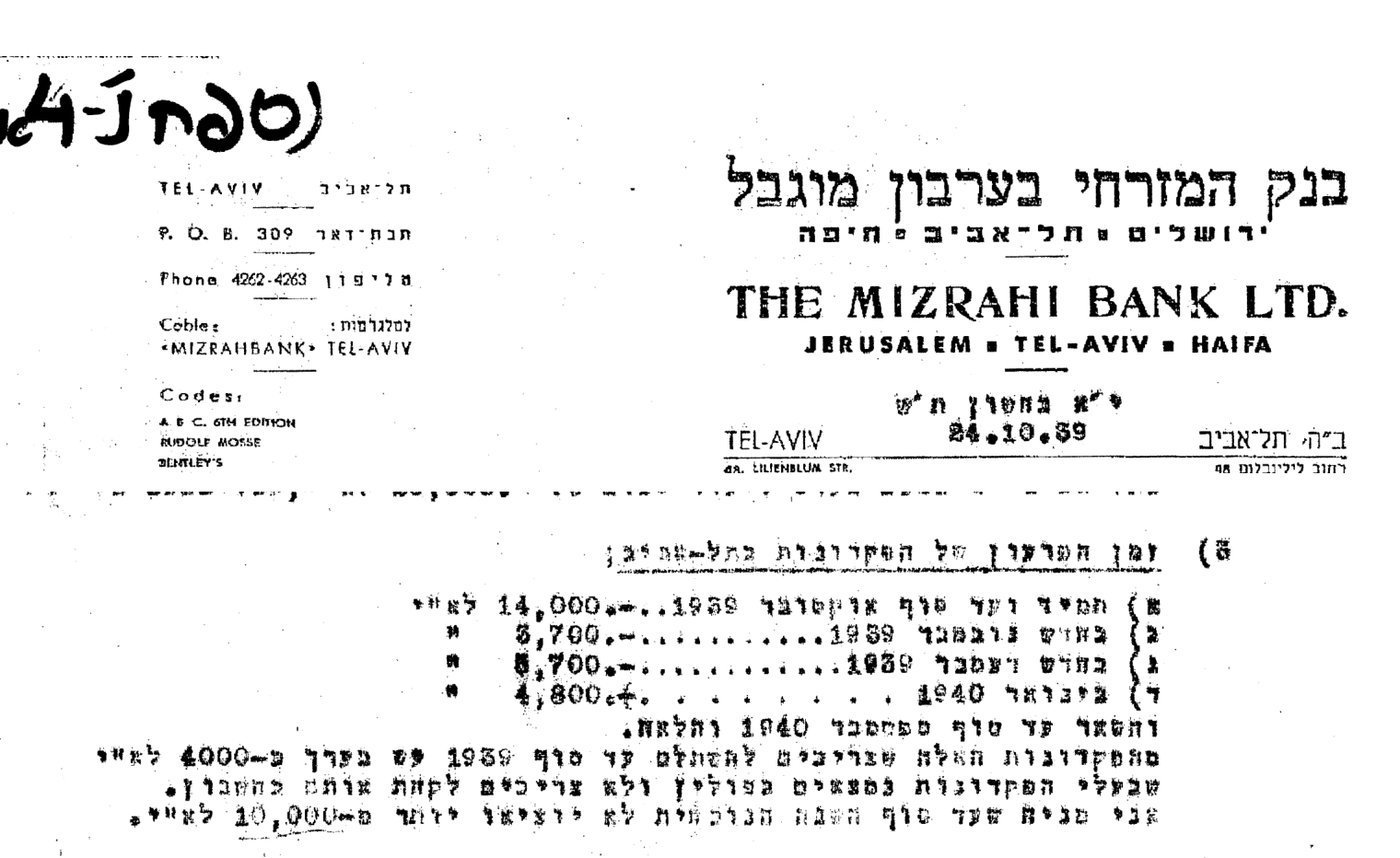
- 24 October 1939: about 4,000 Palestine pounds "whose depositors are in Poland and should not be taken into account".
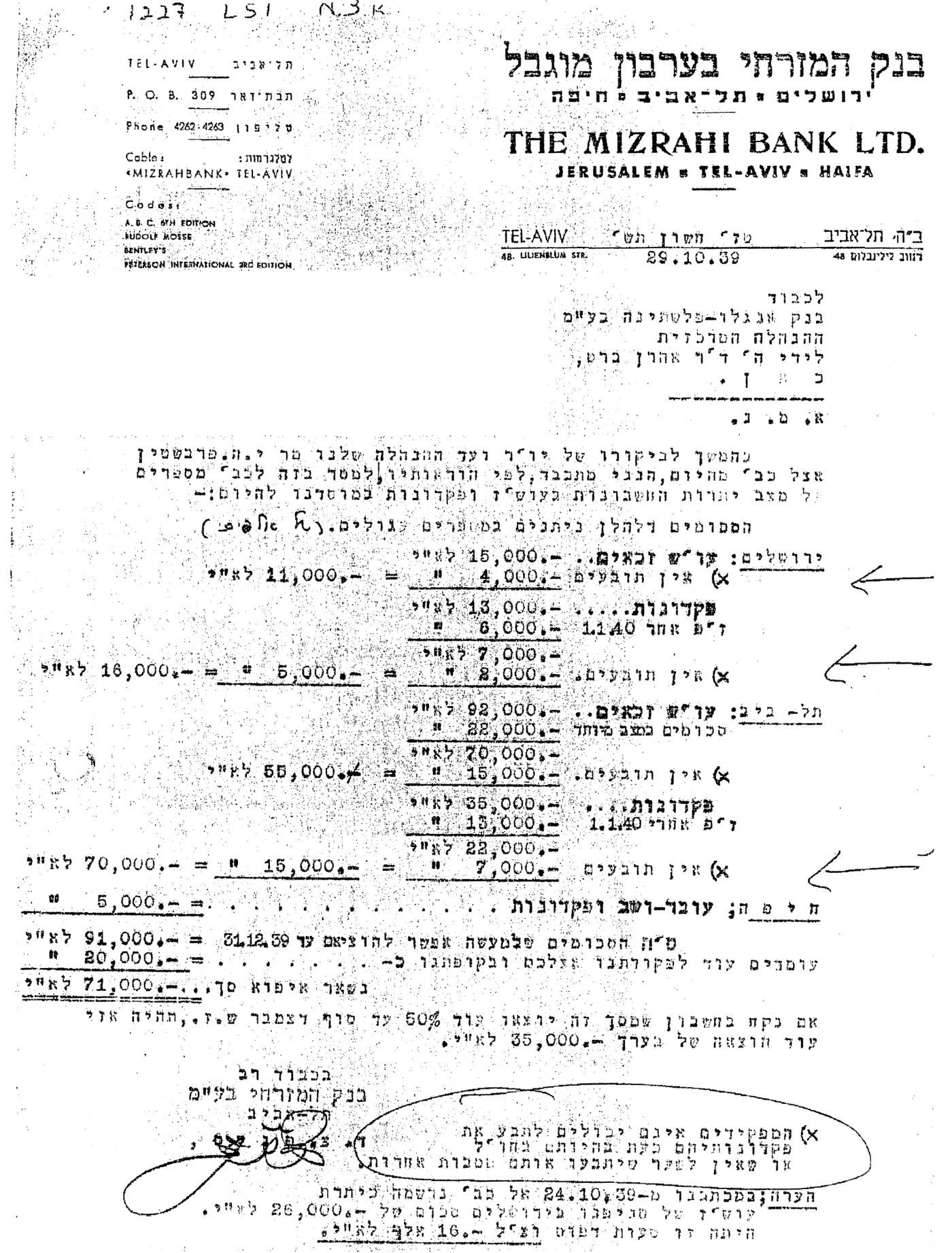
- 29 October 1939: 28,000 Palestine pounds marked "no claimants", because "the depositors cannot claim their deposits at present, being abroad".
- 13 December 1940: in a letter to the Supervisor of Banks, 1,596 Palestine pounds "of accounts whose owners died".
- 2001: the auditors were told that "the bank has no material at all relevant to the audit".
1939: "they should not be taken into account"
At the end of August 1939 a wave of withdrawals hit the banks in Mandatory Palestine. In those weeks Mizrahi Bank reported to the head office of the Anglo-Palestine Bank how much money it expected to be withdrawn. Two letters from that period appear as appendices to the report, scanned from the originals.
24 October 1939. The letter is signed by Willy David, the bank's acting manager. In the section on the repayment dates of the Tel Aviv deposits he wrote: "Of these deposits, which are due to be paid by the end of 1939, there are about 4,000 Palestine pounds whose depositors are in Poland, and they should not be taken into account."
29 October 1939. The Tel Aviv branch letter is signed by Dr. Z. Pinkas. In its table four lines are marked with an x as "no claimants": in Jerusalem 4,000 Palestine pounds in current accounts and 2,000 in deposits, and in Tel Aviv 15,000 in current accounts and 7,000 in deposits. Together, 28,000 Palestine pounds. Next to the x a note says: "The depositors cannot claim their deposits at present, being abroad, or it cannot be assumed that they will claim them for other reasons."
According to the report, detailed Tel Aviv branch records were attached to the letter, listing account numbers, account holders' names and deposit amounts.
1940: "whose owners are abroad, deceased"
The minutes of the management board meeting of 16 August 1940 refer to "amounts whose owners are abroad, deceased, or accounts without activity". A list dated 28 June 1940 includes a line for "accounts whose owners abroad died or that have had no activity for a long time", totalling 22,200 Palestine pounds.
On 13 December 1940 the bank wrote to the Supervisor of Banks at the government offices in Jerusalem, itemising accounts that were not expected to be claimed. Three items from the letter:
- 5,938 Palestine pounds in accounts "in which there was no activity at all" since the beginning of 1939.
- 1,596 Palestine pounds "of accounts whose owners died".
- 17,269 Palestine pounds "of accounts whose owners are, as far as we know, abroad". Of these, according to the letter, "a considerable part belongs to Russia and cannot easily be claimed at this time".
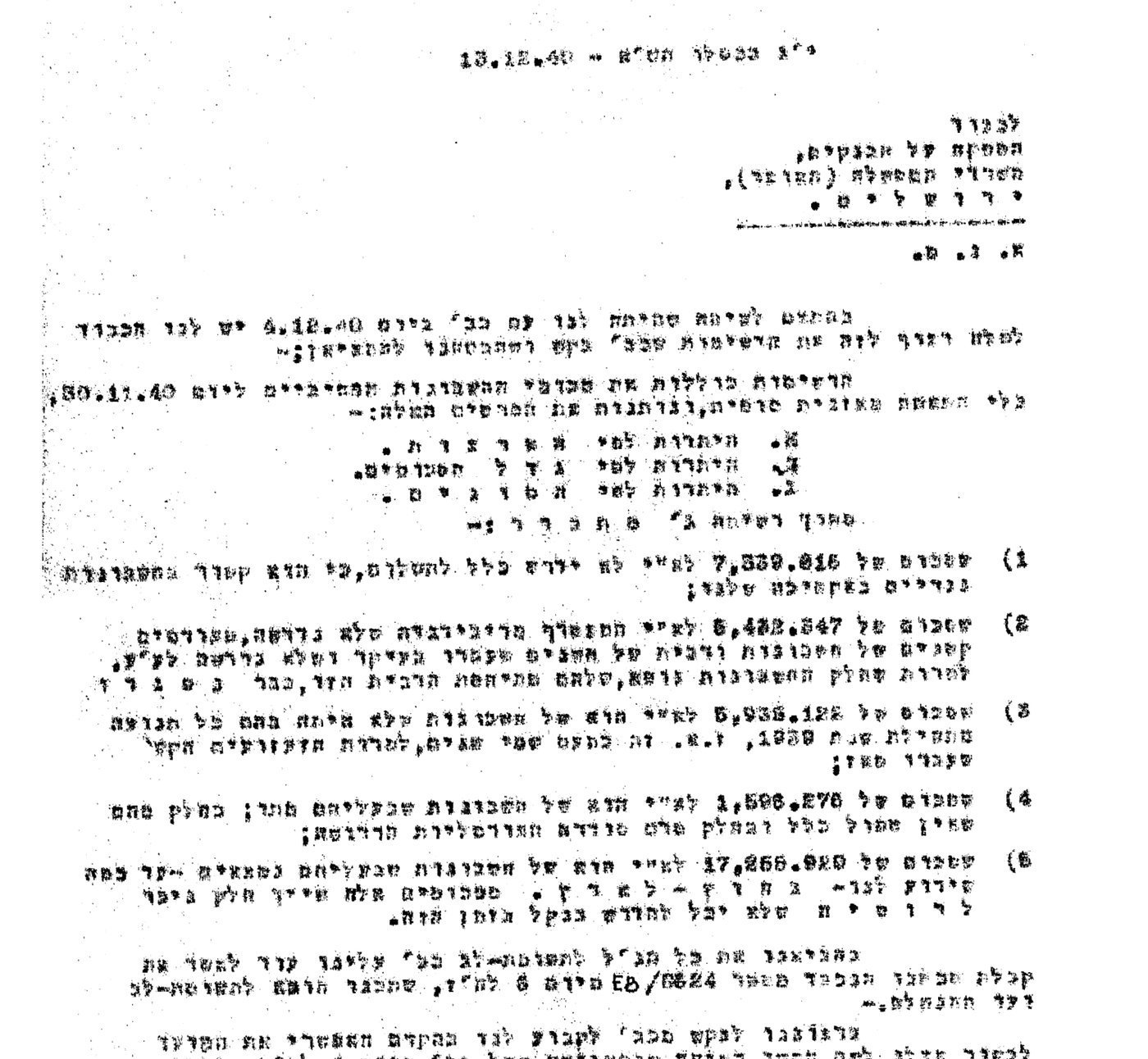
The auditors wrote that these reports show the bank's management clearly knew that some depositors were foreign residents, including from occupied countries. They also wrote that a bank declaring that deposits will not be claimed "is in effect declaring that these customers' money has become the bank's money".
2001: "the bank has no material at all"
The auditors noted in the report: "At the first meeting with the bank's management we were told that the bank had no material at all relevant to the audit, and that we would find nothing in the course of our work."
A retiree, formerly a senior bank employee, told the auditors "that the bank never had customers from Europe at all". The auditors added that they found account books whose owners lived abroad.
In the end they found original bound account books, signature cards from the late 1930s to the late 1940s, and minutes of board meetings. We wrote about the documents that were lost, and about the 2012 settlement, in the article on the lost documents.
What we do not know
The 1939 letters were written to work out how much cash to hold during the wave of withdrawals. "Should not be taken into account" means these depositors were not expected to withdraw their money. What later happened to each of these accounts, the documents do not say. The bank disputed the committee's findings and did not admit liability.
The documents
- The original letters of 1939 and 1940, appendices 4a, 4b, 4c and 4g of the report, in Hebrew (PDF)
- Appendix 3 of the inquiry report: the Mizrahi Bank audit, selected pages, in Hebrew (PDF)
Based on the report of the parliamentary inquiry committee and the original letters scanned as its appendices. Quotes are translated from the Hebrew originals; amounts are in Palestine pounds. The Hebrew version of this article prevails. This is not legal advice.