On 25 October 2026, a customer of Bank Mizrahi Tefahot received a letter from the law firm Pearl Cohen Zedek Latzer Baratz. The letter is signed by Israel Bachar, Adv., and Tal Kaplan, Adv., and was sent on behalf of the bank, with a copy to the bank.
The heading: "Warning prior to taking legal proceedings". The subject: this website.
The demand in section 13.3 of the letter: "To remove the website from the internet without delay, to delete the website from every storage medium on which it is stored, and to undertake in writing not to publish the website, or a website similar to it, in the future".

Not to correct a particular publication. Not to add a response. To delete everything, and to undertake not to publish again.
The website publishes judicial decisions, pleadings, hearing transcripts, the transcript of a recording, and documents that the bank itself provided to the customer in response to an access request. All of them concern proceedings that the bank and its subsidiary, Mizrahi Tefahot Leasing, are conducting against the customer.
In brief
- On 25 October 2026, the Pearl Cohen firm, on behalf of Bank Mizrahi Tefahot, demanded that the website be removed, that it be deleted "from every storage medium", and that the customer undertake not to publish "a website similar to it, in the future".
- The letter was written one day after the hosting company Hostinger put the website back online, after a report against it on grounds of "defamation" was found not to involve a violation of its terms of service. Who filed the report is unknown.
- The letter links the website to "debt and enforcement proceedings" and adds: "This attempt will not succeed." The same sentence, in almost identical wording, appeared in an email from the bank in March 2026, in reply to the customer's request to inspect the information collected about him.
- On 27 October 2026, the customer rejected all the demands in a reply letter, and on the same day filed an application with the Netanya Magistrates' Court on grounds of abuse of legal process.
What the letter claims
The letter opens with a description of the bank: "one of the leading banks in Israel", "the third-largest bank in Israel", the owner of registered and well-known trade marks. According to the lawyers, the website's domain name includes the bank's name "with egregious bad faith", and the website is used for "blackening our client's name" and for "conducting an extensive and offensive smear campaign".
In section 11, the letter lists eight causes of action: infringement and dilution of trade marks, obstruction of access to the bank's business, passing off, misappropriation of goodwill, unjust enrichment, bad faith, negligence and defamation. The letter mentions compensation of up to NIS 100,000 without proof of damage.
And in section 6, one sentence that stands on its own: "For the avoidance of doubt, the bank holds detailed documentation regarding the website and its contents".
One day after Hostinger
On 19 October 2026, the website was taken down, and the domain name frozen, by the hosting company Hostinger. On 22 October, the company informed the customer that the suspension followed a report concerning "defamation", and refused to disclose the report or the identity of the person who filed it. On 24 October, the company announced that the reported activity did not violate its terms of service, and restored the website.
The next day, 25 October, the demand letter was written. Its main cause of action is the same one: defamation.
Who filed the report with Hostinger is unknown, and this article does not determine that the bank or its lawyers filed it. The customer has asked the court to order the bank to state in an affidavit whether it contacted the hosting company.
"This attempt will not succeed"
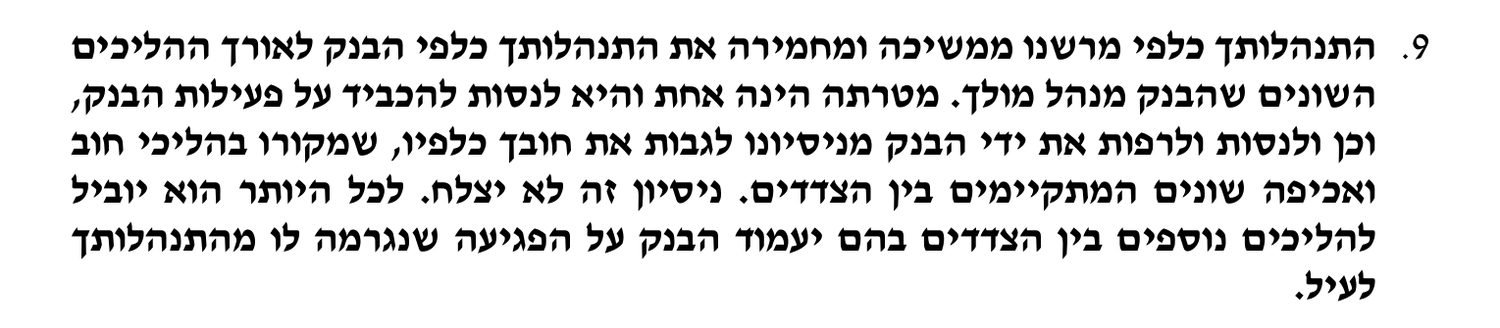
Section 9 of the letter explains what, in the lawyers' view, lies behind the website:
Seven months earlier, on 5 March 2026, the bank's privacy inquiries mailbox replied to the customer's request to inspect the information collected about him. The email was sent by Idit Barshadsky-Cohen, head of the bank's Measurement and Control Unit. Section 7 of it reads:
"...while attempting to exert improper pressure on the bank and on the company, with the aim of trying to burden their activity and trying to weaken their resolve in their attempt to collect your debt to them. This attempt will not succeed."
And in the October letter: "Its purpose is one, namely to try to burden the bank's activity, and to try to weaken the bank's resolve in its attempt to collect your debt to it [...] This attempt will not succeed". And in section 8: "a distasteful attempt to exert improper pressure on the bank".
The same language. In March, it was said of a customer who asked to see the information the bank collects about him. In October, it was said of a customer who publishes the documents of the proceedings against him.
The same March email also told the customer that section 11 of the Protection of Privacy Law does not give him a right "to conduct a 'fishing expedition' into the privacy practices of the bank and the company". To his request to inspect an "economic investigation" and a "background check report" prepared about him, the bank had already replied in February: "Your request is denied", citing attorney-client privilege.
The reply: "The claims and demands in your letter are rejected in their entirety"
On 27 October 2026, the customer replied in writing: "I will not transfer the domain name, I will not remove the website, I will not delete material in my possession, and I will not give any undertaking regarding future publication".
The domain name. According to the reply, proceedings entitled "Bank Mizrahi Tefahot Ltd. v. Yagudin Sergey" are pending in the Netanya Magistrates' Court, and the domain name "is nothing but a reference to the name of the proceedings". Trade mark infringement under the Ordinance is use of a mark in relation to goods. "The website has no goods, no service, no sale and no competition".
Commercial torts and unjust enrichment. The customer is not a "dealer" in his relations with the bank, sells nothing and has received no benefit. The website "is not commercial, carries no advertising and generates no income". The reply also notes that the provision for compensation without proof of damage, to which the letter referred, is found in section 13(a) of the Commercial Torts Law and not in section 1(a) as stated.
Defamation. According to the reply, a "correct and fair report" of what was said at a public court hearing is permitted under section 13(7) of the Prohibition of Defamation Law, and a truthful publication that is in the public interest is protected under section 14. "Your letter does not point to a single publication, not even one, that is untrue".
The deletion. The demand to delete the material "from every storage medium" is, according to the reply, a demand to destroy evidentiary material in the midst of proceedings: "A demand to destroy evidentiary material in the midst of legal proceedings cannot be voiced by lawyers".
Litigant and witness. The customer is a defendant in a claim brought by the bank in the Netanya Magistrates' Court (CC 25207-08-26), has filed an affidavit in it and is due to testify. The reply cites Regulation 4 of the Civil Procedure Regulations, which prohibits an act whose purpose or effect is to harass a litigant, and section 249 of the Penal Law, which prohibits harassing a person "in relation to testimony the person gave, or is about to give, in a judicial proceeding".
The detailed documentation. According to the reply, the statement that the bank holds "detailed documentation" indicates that personal information about the customer was collected without his knowledge and without his consent. The customer demanded, within 14 days, a notice under section 11 of the Protection of Privacy Law, inspection of the information collected about him, a copy of every approach to Hostinger or to any other party concerning the website, and the sources of the "detailed documentation". He also demanded that all documents be preserved and that nothing be deleted.
The application to the court
On 27 October 2026, the customer filed with the Netanya Magistrates' Court, in the case in which the bank is suing him, an application for directions on grounds of abuse of legal process and for exemplary costs. In the application he asks the court to find that the demand letter is an abuse of legal process, to order the bank to state in an affidavit whether it contacted Hostinger, to order that any communication with him in connection with the proceedings and his publications be made in writing and within the court file only, and to order the bank to pay exemplary costs.
The application has not yet been heard. As far as this website is aware, the bank has not filed a response.
The documents
Both letters are published here in full, in an unofficial English translation alongside the Hebrew original. The customer's identifying details (ID number, address, telephone number and email address) have been redacted.


What this article does not determine
The article does not determine who filed the report with Hostinger, nor does it determine that the demand letter is an abuse of legal process. That is the question the customer has brought before the court, and no court has ruled on it. The legal arguments in both letters are the positions of the parties.
Questions for Bank Mizrahi Tefahot
- Did the bank, its lawyers or anyone acting on its behalf contact Hostinger about the website?
- What is the "detailed documentation" the bank holds about the website, and when did the bank begin collecting it?
- Which publication on the website, if any, is untrue?
- Why was deletion "from every storage medium" demanded for documents concerning proceedings that are still ongoing?
- Why does the same sentence, "This attempt will not succeed", appear both in the bank's reply to a request to access personal information and in the demand letter?
This article is based on the Pearl Cohen Zedek Latzer Baratz letter of 25.10.2026, the customer's reply letter of 27.10.2026, the email from the bank's privacy inquiries mailbox of 5.3.2026, the bank's letter of 4.2.2026, the application for directions filed in CC 25207-08-26 (Netanya Magistrates' Court) and the correspondence with Hostinger from 19 to 24 October 2026. Quotations from these documents are translated from Hebrew; the Hebrew documents are the authoritative versions. The bank's response will be published if received.
Read also
- Defamation in the presence of a Bank Mizrahi Tefahot representative
- The right to inspect information and attorney-client privilege
- Court rulings against Bank Mizrahi Tefahot: a complete, up-to-date database
- He asked to defer a payment during the war, and found an order barring him from leaving the country