On three dates roughly eighty years apart, the same banking group made the same kind of entry: a person who could not reach the bank was recorded, in the bank's own papers, as someone who would not be claiming. This article sets the three entries side by side and quotes them from the documents themselves.
Let us say the obvious first. These events are not comparable in gravity. Nothing is. What is being compared is an entry — the way a financial institution records, in its own books, a person who cannot reach it.
In short
- 1939: the acting manager of Bank HaMizrahi writes of deposits belonging to people in Poland that they "need not be taken into account".
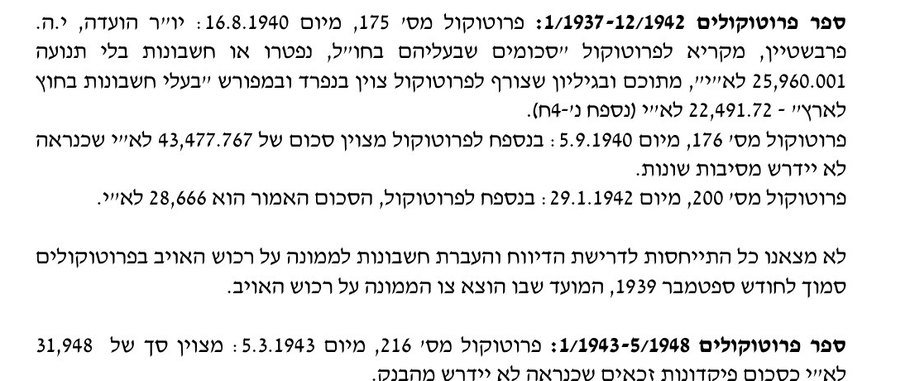
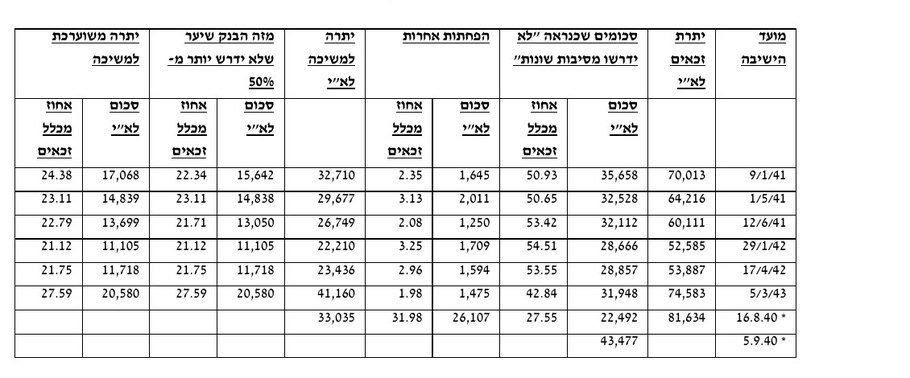
- 1940–1943: those sums become a standing item in board minutes. At some meetings, more than 50% of everything owed to creditors.
- The examiners' conclusion: the entries were made "in order to obtain increased bank credit", and amount in substance to a declaration that the customers' money "had become the bank's money, in the bank's till".
- 2023: the bank's systems record that a reply to a customer is delayed: "there are many requests because of the situation, and so it is delayed".
- 2024: in the same matter it is declared in proceedings that "attempts to contact the debtor... came to nothing". The statutory warning was served ten months after the receiver was appointed.
- 2026: the registrar finds that the debtor was outside Israel on the reported date of service, and cancels the service entry.
October 1939: "they need not be taken into account"
In 2000 the Knesset established a parliamentary commission of inquiry into the location and restitution of Holocaust victims' assets. Kaspi & Kaspi, Certified Public Accountants, were appointed to examine Bank HaMizrahi, and their findings were filed as Appendix 3 to the commission's report.
In the bank's archive the examiners found correspondence with the management of Anglo-Palestine Bank. In a letter of 24 October 1939, Mr Willy David, the bank's acting manager, wrote in a clause the examiners emphasised:
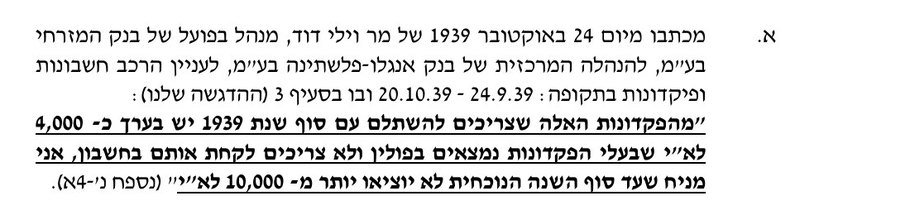
The full sentence matters. This is an estimate of expected withdrawals. The letter does not say the money was lost, and it was not sent to depositors — it is an internal letter between banks.
Five days later, on 29 October 1939, the manager of the Tel Aviv branch wrote a note beside deposit and current-account sums of some 28,000 Palestine pounds:
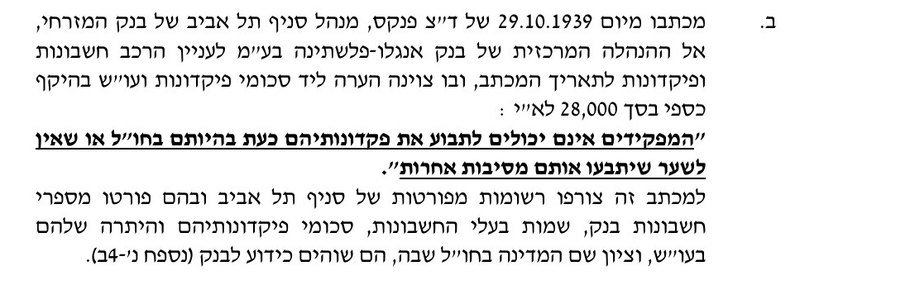
It was not one letter
The significant finding is not the single letter but what followed it. These sums became a recurring item in the minutes of the bank's management. On the same page there is also one line the examiners expressly recorded as missing:
The report sets out a summary table showing these sums as a percentage of all the bank's creditors. At one meeting: 35,658 out of 70,013 — 50.93%. At the next: 32,528 out of 64,216 — 50.65%.
In parallel, analysis of the financial statements shows that between 1938 and 1942 public deposits fell by 88.6%, while "creditors and other credit balances" grew over those same years by 117%.
What the bank knew at the time
The examiners did not stop at the sums. They also quoted a draft management letter found in the archive, with deletions and corrections by a senior figure at the bank:

Why it was recorded that way
The examiners did not stop at description. They wrote an express conclusion:

The bank disputed some of the commission's findings. In November 2012 it paid NIS 9.5 million to the Company for Location and Restitution of Holocaust Victims' Assets, expressly without admitting liability, describing the payment in its announcement as made beyond the letter of the law. On what was lost and what was found in the bank's archives, see The bank lost the documents? When does that usually happen?
October 2023: "because of the situation, and so it is delayed"
Eighty-four years later, at the outbreak of the Iron Swords war, a borrower of a leasing company in the Mizrahi Tefahot group approached the lender to arrange his vehicle loan before leaving Israel. According to the document he filed in the proceedings, the bank's systems recorded why no reply was coming: "There are many requests because of the situation, and so it is delayed."
He says he was then told that no loan existed in his name. As later emerged, the loan had not been registered under his identity-card number but under a loan number only. On the change of lender and what happened to customers after the merger, see Igud Leasing: what happened to customers after the merger with Mizrahi Tefahot.
June 2024: "attempts to make contact came to nothing"
A decision given at the Haifa Execution Office on 13 January 2026 describes what happened next. The file was opened on 24 June 2024 to realise a vehicle pledge; in the absence of payment the creditor declared the entire loan due; and by a decision of 1 July 2024 a receiver was appointed over the debtor's rights in the vehicle — one week after the file was opened.
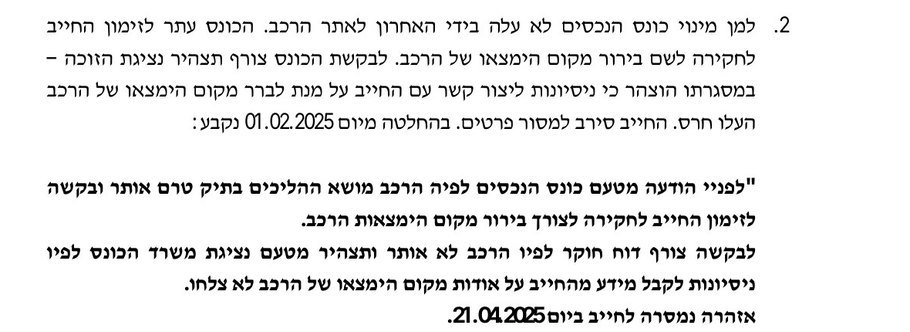
The file was opened on 24 June 2024. The receiver was appointed a week later. The warning — the document from which the period for filing an objection runs — was served some ten months after that. On how vehicle receivership works and what rights a debtor has, see Vehicle receiver: how it works and what your rights are.
And then it was found that he had been abroad
In the same decision the registrar examined the official travel record from the Population and Immigration Authority, and held:

In other words: the declaration that contact could not be made, and the service on which the proceedings rested, were examined — and the service was cancelled. The pattern of service in this file is examined at length in False service reports by Mizrahi Tefahot Bank and Sewer Service ISRAEL: the American practice that reached the Execution Office, and the exit ban in Exit ban: how Mizrahi Tefahot Leasing sought to restrict a customer who was already abroad.
What the three entries have in common
In 1939, people who could not come and claim were recorded separately, and according to the examiners that record served as a basis for credit. In 2023 it was recorded that a reply to a customer was delayed because of the situation. In 2024 it was declared in proceedings that he could not be contacted.
In all three, a person's inability to reach the bank is not described as a problem for the bank to solve. It is described as a given — and in the first case, according to the examiners, as a resource.
What we do not know
- The full text of the 2012 settlement was not published. What is known of it comes from the bank's own announcement and reports.
- The examiners wrote "in our opinion" and "it is reasonably likely". This is the conclusion of accountants appointed by a commission of inquiry, not a finding of a court.
- The proceedings concerning the borrower are pending. Nothing set out here is a judicial finding on the matters in dispute.
The documents
- Appendix 3 to the commission's report, pages 8–10: the 1939 letters, the board minutes and the conclusion (PDF, Hebrew)
- Appendix 3: examination of Bank HaMizrahi, selected pages (PDF, Hebrew)
- The commission's final report: the Bank HaMizrahi pages (PDF, Hebrew)
- The full final report of the parliamentary commission of inquiry, on the Knesset website
- Decision of the Haifa execution registrar in file 515509-06-24 of 13 January 2026. The quoted passages are reproduced here as images; the full decision contains identifying details and is not published on this site.
Further reading
- The bank lost the documents? When does that usually happen?
- Mizrahi Tefahot and the US Department of Justice: a $195 million settlement
- Mizrahi Tefahot collection proceedings: how a request to settle a debt became an arrest order
- How do you know how much you really owe Mizrahi Tefahot Bank?
- The Banking Supervisor: how to file a complaint against Mizrahi Tefahot Bank