Anyone looking for a way to settle a debt with Mizrahi Tefahot Bank ends up with one question: exactly how much has to be paid. The service channels page of Mizrahi Tefahot Leasing lists a “request to settle a debt in loan payments”, a “request to repay a loan” and “receiving information about a loan”. But a debt settlement starts with a number, and if the number is wrong, the settlement is wrong too.
One of the bank's clients decided not to trust the number. He asked for the account ledger, cross-checked every line in it against the decisions in the enforcement cases, and found two small lines.
The first is called “שכ״ט ב׳” (attorney fee, stage B), in the amount of 21,456.50 shekels. It has no case number, no decision and no request. The amount is identical to the agora to an attorney fee that the Enforcement Registrar had cancelled nine months earlier. The second is interest added to a daily charge set in a decision, even though the decision said not a word about interest.
Together: 22,068.79 shekels. In addition, 4,000 shekels were seized from deposit money held in a court fund, and the official debt report, in the column “paid and deducted from the debt”, shows: 0.
This is how a debt to a bank is checked, step by step, and what came out of this check.
What the bank offers those who want to pay
According to the service channels page of Mizrahi Tefahot Leasing, a request to settle a debt in loan payments is submitted by phone only, at the loans call center 076-8887080, Sunday to Thursday between 8:15 and 18:30. On the website one can submit a request to repay a loan and a request for a letter of intent before repayment. The request to remove a lien appears on the page as a separate service.
In the case described in this article, the loan was transferred “for legal handling” on 1 April 2024, with a balance of 153,026.86 shekels. The creditor in the enforcement cases is Mizrahi Tefahot Leasing Ltd., represented by the Chen Fisher Gabbay law office. A bill case and a pledge case on the vehicle were opened. From that moment on, every shekel is added to the debt in the account ledger and in requests to increase the debt.
Step 1: Ask for the account ledger, and check where each amount came from
In the pledge case, the Registrar ordered the receiver, Victor Fisher, attorney, of the Chen Fisher Gabbay office, to submit an updated printout of the debt balance. On 3 August 2026 a Mizrahi Tefahot Leasing account ledger produced on 22 July was submitted. Its last line:

The two previous attorney fee lines in the ledger refer to a case number. This line refers to no case, no decision and no request. It raised the balance to 201,084.08 shekels.
The amount is familiar. On 21 October 2025, after it emerged that the client was outside Israel on the date when service of the warning was reported, the Enforcement Registrar cancelled the proceedings in the bill case and wrote:

A reduction of 21,456.50 shekels was then recorded in the enforcement case. On 22 July 2026 there was no decision in any case approving such a charge again.
What happened when the client asked
On 10 August the client asked the Registrar for instructions to the receiver, among other things a reference for the line. On 11 August he sent the privacy protection officer at Mizrahi Tefahot Bank and at Mizrahi Tefahot Leasing a request to inspect and correct the information, under sections 13 and 14 of the Privacy Protection Law. According to him, no reply to this request has arrived to this day.
The Registrar noted in her decision that the ledger included an attorney fee component “even though this component was seemingly cancelled”, and ordered the creditor to clarify the reason. On 25 August a new line appeared in the ledger, “cancellation of stage B fee per judicial decision”, and the balance dropped by exactly that amount.

The explanation came on 31 August, in a response signed by Victor Fisher, attorney, counsel for the creditor and receiver:

“Technical gap” is the version of the party in whose books the line appeared. No documentation was presented alongside it: no system log, no name of the person who entered it, no document on which the line relied. The client does not accept the explanation. In his view, a line with no source, which bears the name of a familiar component and exactly the amount of a cancelled component, is a line that, if caught, can be called a mistake, and if not caught, will be collected. Which of the two possibilities is true can only be shown by the bank's internal record. It was not presented.
On the same day, 31 August, a new request to award a stage B attorney fee was filed in the bill case, and the Registrar approved it on 9 September “as requested”. From then on the attorney fee has a basis in a decision. But on 22 July, when the line appeared in the ledger, that basis did not exist. The approval came seven weeks after the line, and only after the client found it.
Step 2: Check the requests to increase the debt
In the pledge case, a charge of 100 shekels for every day the vehicle was not deposited was set on 13 January 2026, starting 19 January. The charge itself was set in a decision, and it is not the subject of this article. The decision did not set interest on this charge.
In June a request to increase the debt was filed. The attached affidavit said only “plus legal interest”, with no rate, no date and no source. In the calculation sheet:

The arithmetic does not add up. 13,500 plus 301.66 is 13,801.66 shekels. The sheet shows 13,969.06. That leaves 167.40 shekels that appear in no column. In total, 469.06 shekels were added above the daily charge. On 7 July a debt increase of 13,969 shekels was approved, and the interest line was not addressed in the decision.
In September another request was filed: 95 days times 100 shekels, 9,500 shekels. In the sheet: 9,643.23.

The sheet refers to the Adjudication of Interest and Linkage Law. But the decision that created the charge did not award interest. The client asked under which decision or legal provision the interest was added, what its rate is, from when it is counted and what the 167.40 shekels mean. As of the writing of this article, no decision has been given on these questions.
Step 3: Check that all money collected was credited
On 18 June 2026, two and a half weeks after his opposition to the enforcement of the bill was rejected, decisions were given in the bill case to realize a third party seizure. One of them applies to deposit money placed in a court fund in another proceeding.
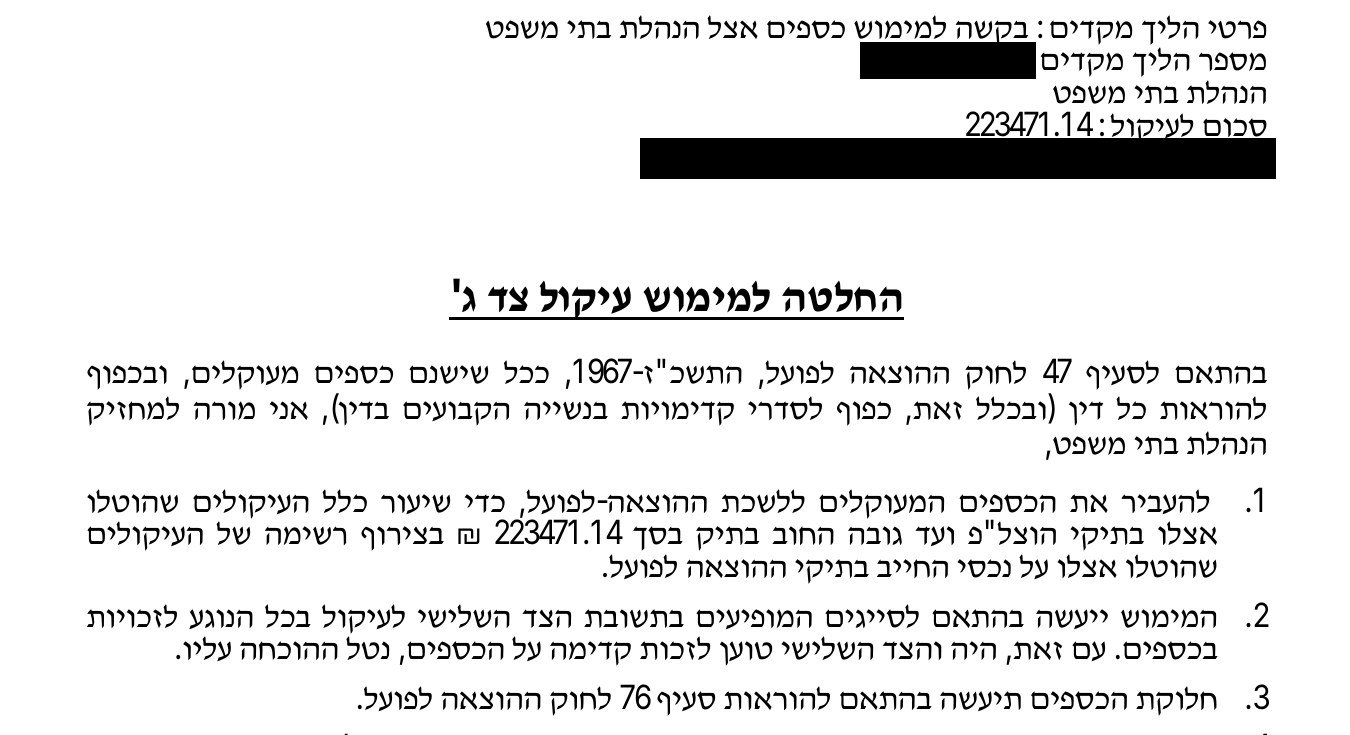
According to the client, 4,000 shekels were taken from the deposit. What is known for certain is what appears in the debt breakdown report of the Enforcement and Collection Authority in the bill case, produced on 20 September 2026, three months after the realization order:
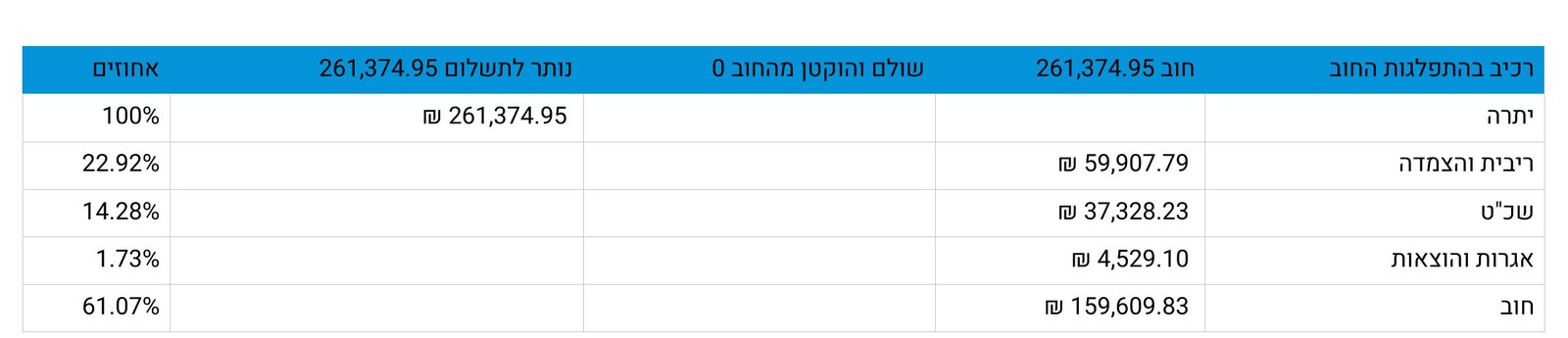
Zero. The money does not appear as a credit against the debt, and according to the client it was not returned to him either. If it was transferred, someone is holding it. If it was not transferred, someone needs to say so.
The calculation
| Component | Amount in NIS | Source |
|---|---|---|
| “שכ״ט ב׳” line with no case and no decision, 22.7.2026 | 21,456.50 | Mizrahi Tefahot Leasing account ledger |
| Addition above the daily charge, June sheet (interest 301.66 and unexplained gap 167.40) | 469.06 | Calculation sheet 3.6.2026 |
| Interest on the daily charge, September sheet | 143.23 | Calculation sheet 7.9.2026 |
| Total | 22,068.79 | |
| Separately: seized deposit that did not appear as a credit | 4,000.00 | Realization decision 18.6.2026, debt report 20.9.2026 |
The line was deleted from the ledger on 25 August, and a new attorney fee was approved on 9 September. These two facts do not close the question. They sharpen it: if such a charge needed a decision to enter the debt in September, what put it into the debt in July?
Before a debt settlement: what to check
- Ask for a full and updated account ledger, and check that every charge has a case number, a decision or a request next to it.
- Compare every attorney fee component with the Registrar's decisions in the case, including cancellation decisions.
- In every request to increase the debt, check whether interest was added, what its rate is, from when it is counted and whether the decision awarded it.
- In the debt breakdown report on the Enforcement and Collection Authority website, check the column “paid and deducted from the debt” against all money collected or seized.
- If the information is wrong, submit to the bank a request to inspect and correct it under sections 13 and 14 of the Privacy Protection Law, and keep proof of delivery.
Answers required
From Mizrahi Tefahot Leasing and Mizrahi Tefahot Bank:
- Who entered the “שכ״ט ב׳” line of 21,456.50 shekels on 22 July 2026, and on the basis of which document?
- Why is the amount identical to the agora to the attorney fee cancelled in October 2025?
- What is the “technical gap in updating the bank's systems”? When was it discovered, who discovered it, and where is its documentation?
- Did similar lines appear in the ledgers of other clients who asked to settle a debt?
- Why was the client's request of 11 August to inspect and correct the information not answered?
From the Chen Fisher Gabbay law office, counsel for the creditor:
- Under which decision or legal provision was interest added to the daily charge, which the decision of 13 January did not award?
- What is the source of the 167.40 shekels in the June sheet?
- Why does the September sheet record 13 January as the start date of arrears, before the charge began?
From the Enforcement and Collection Authority and the Courts Administration:
- Were funds transferred from the deposit following the realization order of 18 June? How much, when and to where?
- If they were transferred, why do they not appear as a credit against the debt?
A client who wants to pay should not have to be the internal auditor of the body collecting from him. When he is forced to do so, and finds in the ledger a line of 21 thousand shekels with no source, the explanation “technical gap” is not the end of the inquiry. It is the beginning.
Read also: False reports by Mizrahi Tefahot Bank · Sewer Service ISRAEL: the American method that reached the Execution Office
About this article: The article is based on documents filed in the enforcement cases, on decisions given in them and on the service channels page of Mizrahi Tefahot Leasing on the bank's website. What is presented in the client's name is his position, and this is stated explicitly. Identifying details have been redacted. The article makes no determination that any of those involved committed an offense. The article was written with the assistance of artificial intelligence on the basis of the documents, and will be updated if a reply is received.