A bank that accepts a depositor's money accepts a duty with it: to keep it safe and return it to whoever is entitled to it. That fiduciary duty does not lapse when the depositor cannot come and ask. That is exactly when it is tested.
The money that came from Germany
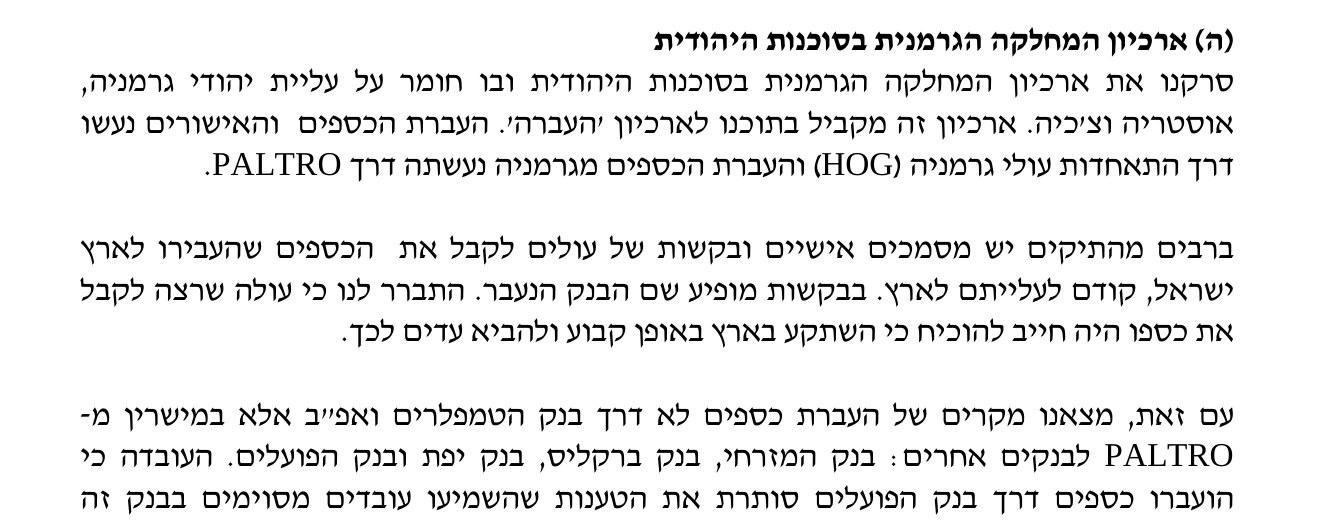
According to Appendix 2 of the report of the Knesset's Parliamentary Commission of Inquiry into the Location and Restitution of Assets of Holocaust Victims (pages 11 and 12), the usual route of the Haavara Transfer Agreement with Nazi Germany ran through the German Templer bank and the Anglo-Palestine Bank. But the examiners wrote: "we found cases in which money was transferred not through the Templer bank and the Anglo-Palestine Bank but directly from PALTRO to other banks: Bank HaMizrahi, Barclays Bank, Bank Japhet and Bank Hapoalim." PALTRO was the Berlin body that ran the transfer on the German side. The number of cases and the amounts were not given.
Deposits "that will not be claimed"
Appendix 3 of the same report quotes Bank HaMizrahi management letters from 1939 and 1940. Beside deposits of 28,000 Palestine pounds: "the depositors cannot claim their deposits, being abroad, or are unlikely to claim them for other reasons." In a mid-1940 document on the bank's true debt: "of which, to the Jews of Germany, Poland and Belgium." The examiners found these were "orders which the bank did not comply with."
Credit against the depositors
The Commission's accountants wrote that in their opinion the reports were intended "to obtain enlarged bank credit from the Anglo-Palestine Bank", and that such a declaration was in effect a declaration "that the money of those customers has become the bank's money in the bank's till." In other words, according to the examiners: the bank sought a larger loan on the strength of money belonging to depositors who could not come back for it.
In 2005 the Commission determined that Bank HaMizrahi should return 12.9 million shekels. In 2012 Mizrahi Tefahot Bank paid 9.5 million shekels in a settlement, without admitting liability.
The full story, including the Templer bank whose building in Jaffa flew swastika flags in 1936, is published in Mizrahi Tefahot Bank and the German Templers: What Lay Between Them.
Source documents
- Appendix 2 to the Commission report, examination at Bank Hapoalim, pages 11 and 12 (PDF, Hebrew)
- Appendix 3 to the Commission report, findings at United Mizrahi Bank, pages 8 and 9 (PDF, Hebrew)
- mizrahi-tefahot-v-yagudin.org
About this article: it is based on Appendices 2 and 3 to the report of the Parliamentary Commission of Inquiry into the Location and Restitution of Assets of Holocaust Victims, TheMarker reports of 2005 and the bank's 2012 announcement. Quotations from Hebrew documents are given in English translation. The article was written with AI assistance on the basis of the documents.