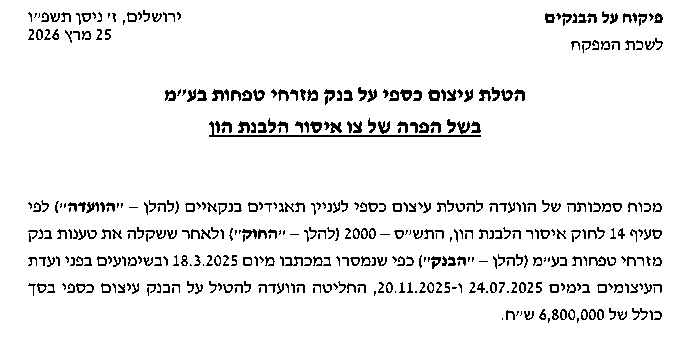
On 25 March 2026 the committee for imposing financial sanctions on banking corporations imposed a NIS 6,800,000 sanction on Mizrahi Tefahot Bank Ltd. under section 14 of Israel’s Prohibition on Money Laundering Law, 5760-2000. The committee was chaired by the Supervisor of Banks, Daniel Hahiashvili, with the head of the Israel Money Laundering and Terror Financing Prohibition Authority, Adv. Ilit Ostrovitz-Levy, and the Deputy Supervisor, Revital Kaiser-Stoia.
The breaches were found in a Banking Supervision Department audit on the prohibition of terror financing, conducted at the bank from January to June 2023. The request to impose the sanction was filed on 16 February 2025. The bank responded in writing on 18 March 2025, and hearings were held on 24 July and 20 November 2025.
In brief
- Shekel transfers from abroad that arrived through another Israeli bank were not screened against the list of designated entities. The committee: a "severe failure in classifying the transactions".
- 12 unusual transactions were not reported to the Authority. The committee: the bank "was negligent in exercising its discretion".
- 37 know-your-customer failures, including 35 business accounts classified as private.
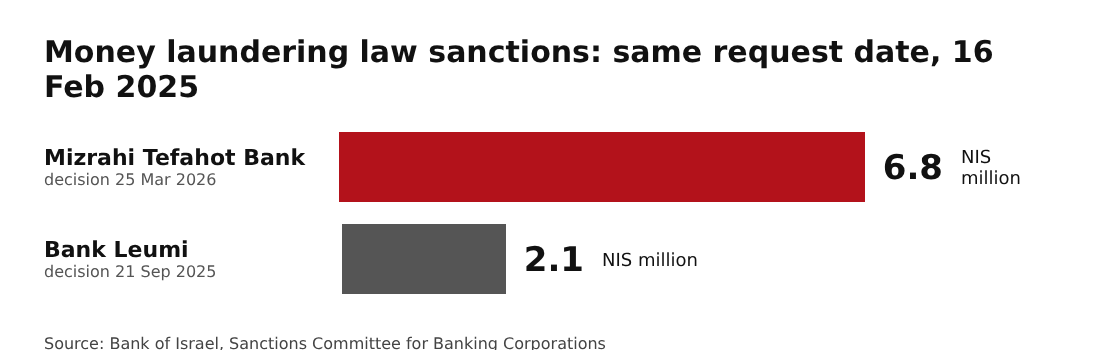
- On the same day a similar request was filed against Bank Leumi, which was fined NIS 2.1 million.
- The committee noted: "this is not the bank’s first breach of the provisions of the law".
The four breaches and the amounts
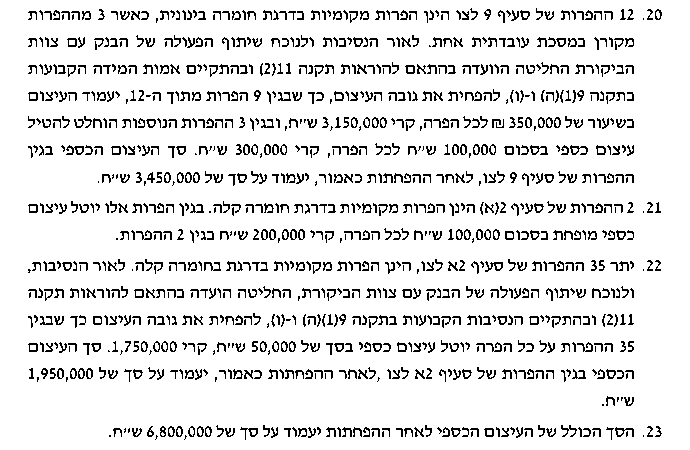
Screening against the list (section 13A of the order). Shekel transfers originating outside Israel and destined for Mizrahi Tefahot, routed through another Israeli bank acting as correspondent, were classified as domestic and not screened against the list. The bank argued its legal interpretation was reasonable. The committee found a "severe failure in classifying the transactions" and held the interpretation "not reasonable in this context". Sanction: NIS 700,000.
Transaction-size reporting (section 8). The bank did not report to the Authority international documentary credit transfers involving countries listed in the fourth schedule of the order. The bank called it a one-off glitch. The committee: had the bank maintained effective controls, "the technical failure would have been discovered by the bank earlier". Sanction: NIS 700,000.
Reporting unusual transactions (section 9). 12 cases. The committee found that "the bank was negligent in exercising its discretion" and "did not properly document, in real time, the reasoning behind not reporting". Sanction: NIS 3,450,000.
Know your customer (section 2A). In two cases the questionnaires were not updated to reflect account activity, and in 35 more, accounts with business activity were classified as private accounts. Sanction: NIS 1,950,000.
Same day, same subject: Mizrahi Tefahot vs Leumi
On 16 February 2025 a request was also filed against Bank Leumi, over an audit on the same subject, terror financing. Leumi was found to have 11 section 9 breaches and 10 section 2A breaches, each reduced to NIS 100,000. Total: NIS 2,100,000, decided on 21 September 2025. At Mizrahi Tefahot there were additional section 13A and section 8 breaches, and nine of the section 9 breaches were assessed at NIS 350,000 each.
Not the first time
On 20 January 2004 Bank Mizrahi was among four entities found to have breached anti-money laundering provisions and received a written warning only, because the law had only recently taken effect. On 19 September 2012 it was fined NIS 3,800,000 over an audit of 2007 to 2010: lawyers’ accounts managed without a beneficiary declaration, unusual transactions not reported, and reports submitted to the Authority significantly late. The 2026 decision states expressly that "this is not the bank’s first breach".
Is the bank required to report?
Two separate duties are involved. The first is the duty to report to the Money Laundering and Terror Financing Prohibition Authority, under section 7 of the law and the order for banking corporations. That is exactly the duty that was breached.
The second is disclosure to investors, because the bank’s shares trade on the Tel Aviv Stock Exchange. On 25 March 2026 the bank filed an immediate report with the Israel Securities Authority and the exchange, signed by Chief Legal Counsel Racheli Friedman and Chief Risk Officer Ofer Horvitz. According to the report, the bank learned of the decision that day at 15:00.
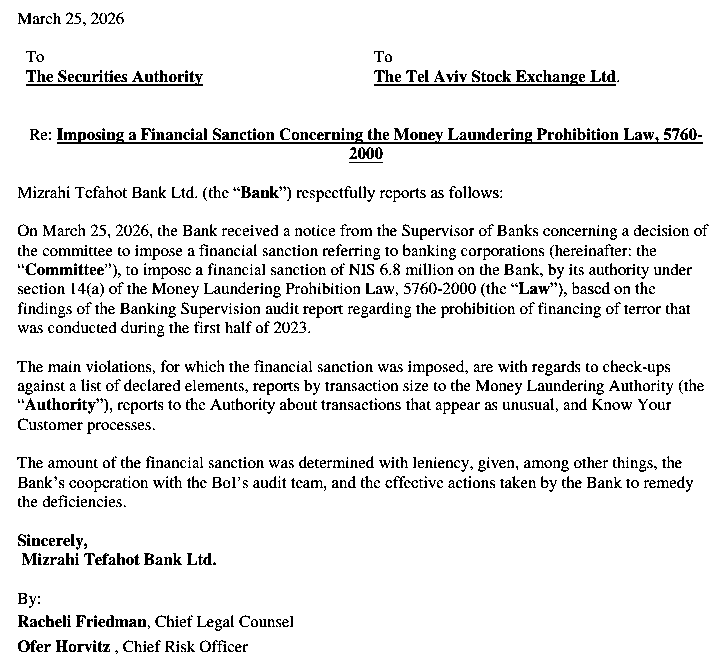
In the bank’s financial statements for the third quarter of 2025, and in its 2025 periodic report approved on 25 February 2026, we found no mention of the request to impose the sanction, although it had been filed a year earlier and both hearings had taken place. In 2012 the bank acted differently: its immediate report of 20 September 2012 stated that the request had already been described in the financial statements as of 30 June 2012, before the decision. NIS 6.8 million is small relative to the bank’s profit, and the disclosure duty depends on materiality. This is a comparison between two courses of conduct by the same bank, not a finding that any duty was breached.
Appeal
Under section 20 of the law, a demand to pay a sanction may be appealed to a magistrate’s court within 30 days, and an appeal does not suspend payment. We found no report of an appeal by Mizrahi Tefahot. Bank Leumi once appealed a NIS 4.2 million sanction, and in 2019 the Jerusalem Magistrate’s Court rejected the appeal (case 48825-07-15). According to the Bank of Israel, the court held that knowing the customer does not exempt a bank from examining a suspicious transaction.
The other side of sanctions
In the same years Mizrahi Tefahot also stood on the opposite side: blocking funds in the name of international sanctions. In April 2026 the Tel Aviv Magistrate’s Court dismissed a couple’s claim against the bank, which had refused to transfer about USD 600,000 that arrived in March 2022 from Alfa-Bank in Russia (Calcalist, 28 April 2026). In 2024 Israel’s Supreme Court upheld the bank’s refusal to transfer a donation from Roman Abramovich to ZAKA.
What we do not know
The identity of the customers, transfers and amounts behind the breaches has not been published. The sanction is an administrative penalty for failures in reporting, screening and controls. It is not a finding that the bank laundered money or financed terror, and it is not a criminal conviction. The bank stated that it remedied the deficiencies, some of them during the audit.
Responses
Any response from Mizrahi Tefahot Bank will be published here in full.
The documents
- Sanctions committee decision on Mizrahi Tefahot Bank, 25 March 2026 (PDF, Hebrew)
- The bank’s immediate report, 25 March 2026 (PDF, English)
- Sanctions committee decision on Bank Leumi, 21 September 2025 (PDF, Hebrew)
- Bank of Israel press release, 25 March 2026 (Hebrew)
Based on decisions of the sanctions committee for banking corporations, Bank of Israel press releases, the Prohibition on Money Laundering Law, 5760-2000, and the bank’s immediate reports and financial statements. Quotes from Hebrew documents are translated. The Hebrew version of this article prevails. This is not legal advice.