The certificate opens with the words "Im Namen des Führers und Reichskanzlers", in the name of the Führer and Reich Chancellor. Below, typewritten: HERMANN STRUCK, Kunstmaler in Haifa, painter in Haifa.
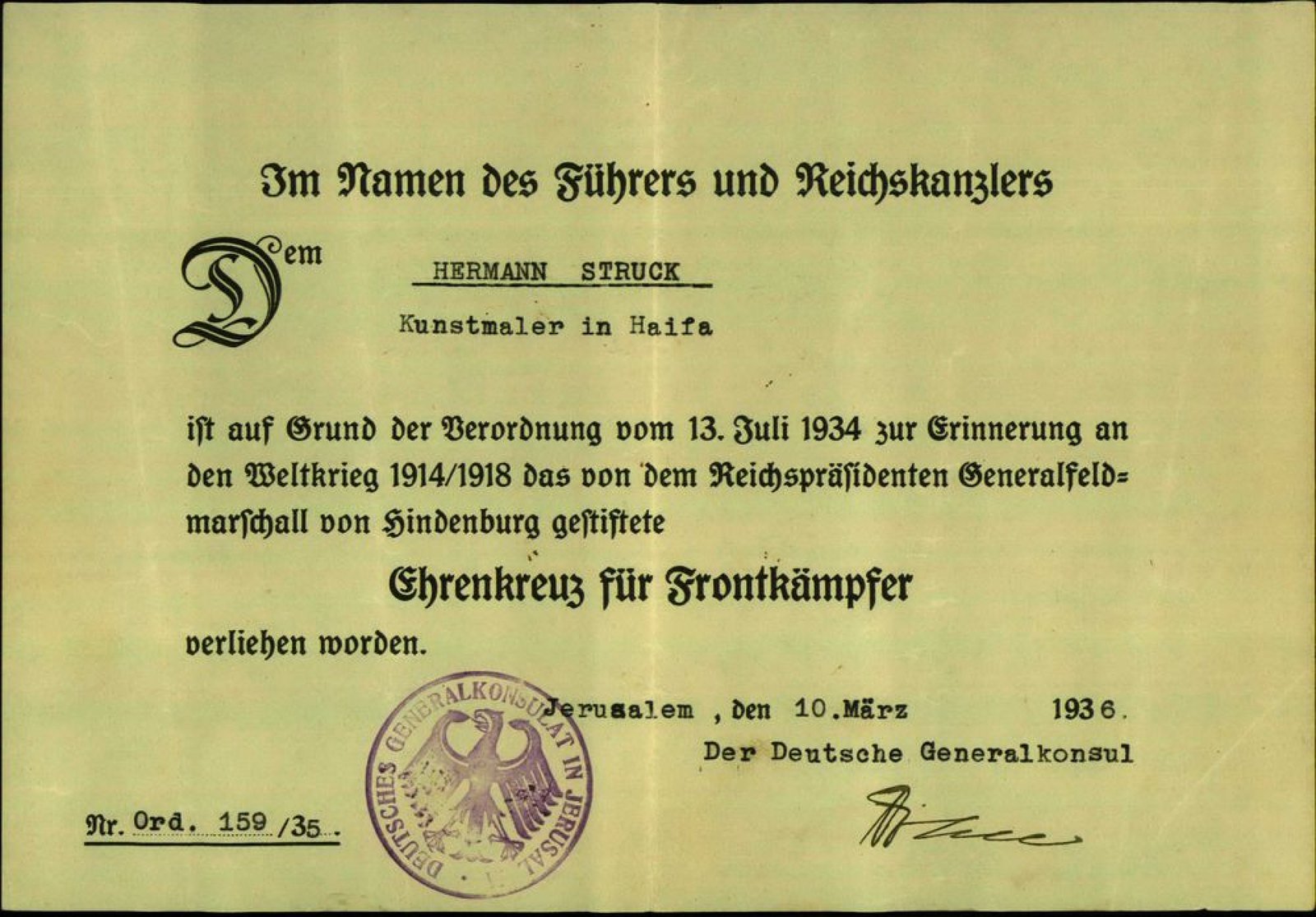
The text continues, in translation: "has been awarded, under the decree of 13 July 1934 in memory of the World War 1914/1918, the Cross of Honour for front-line fighters instituted by the Reich President, Field Marshal von Hindenburg". At the bottom: Jerusalem, 10 March 1936. The signature of the German Consul General, the stamp of the Consulate General in Jerusalem, and the certificate number Ord. 159/35.
The certificate is kept in the Archive for German-speaking Jewry in Israel, Hermann Struck collection, file G.F.0353/10. On the divider sheet before it the archive wrote by hand: "certificate of recognition to Hermann Struck for his military service in World War I", and beside the year, in brackets: "the Third Reich". The archive's accession register gives the date as March 1938. The certificate itself says 1936.
Who received the decoration
Hermann Struck, born in Berlin in 1876, settled in the Land of Israel in the 1920s and made his home in Haifa. He was one of the three holders of the founders' shares of Mizrahi Bank, and signed as a director on the bank's share certificate of 2 November 1924. According to the website of the Meir Ben-Uri museum, the managers in the bank's first five years were Prof. Pick, Rabbi Maimon and Hermann Struck, and Struck was the Mizrachi movement's representative on the board of directors of the Jewish National Fund.
This article does not claim that the decoration was given for his Zionist activity, or that it was a personal honour from Hitler. According to the wording of the certificate, it was given for service in the First World War, through the German consulate, in the name of the head of the regime.
1917: the letter to his mother
Nineteen years earlier, on 23 May 1917, Struck wrote to his mother from the front. Most of the letter is about food parcels from home. Then:
Ich würde dann nach Bialystock übersiedeln und vermutlich Dezernent für jüdische Angelegenheiten werden, wie es Dr. Haax in Warschau ist. Es darf aber darüber nicht gesprochen werden, denn 1.) Ist es ja noch nicht ganz sicher und 2.) könnte es durchkreuzt werden.
In translation: "I would then move to Bialystok and probably become the officer for Jewish affairs, like Dr. Haas in Warsaw. But this must not be talked about, because, first, it is not yet quite certain, and second, it could be thwarted."
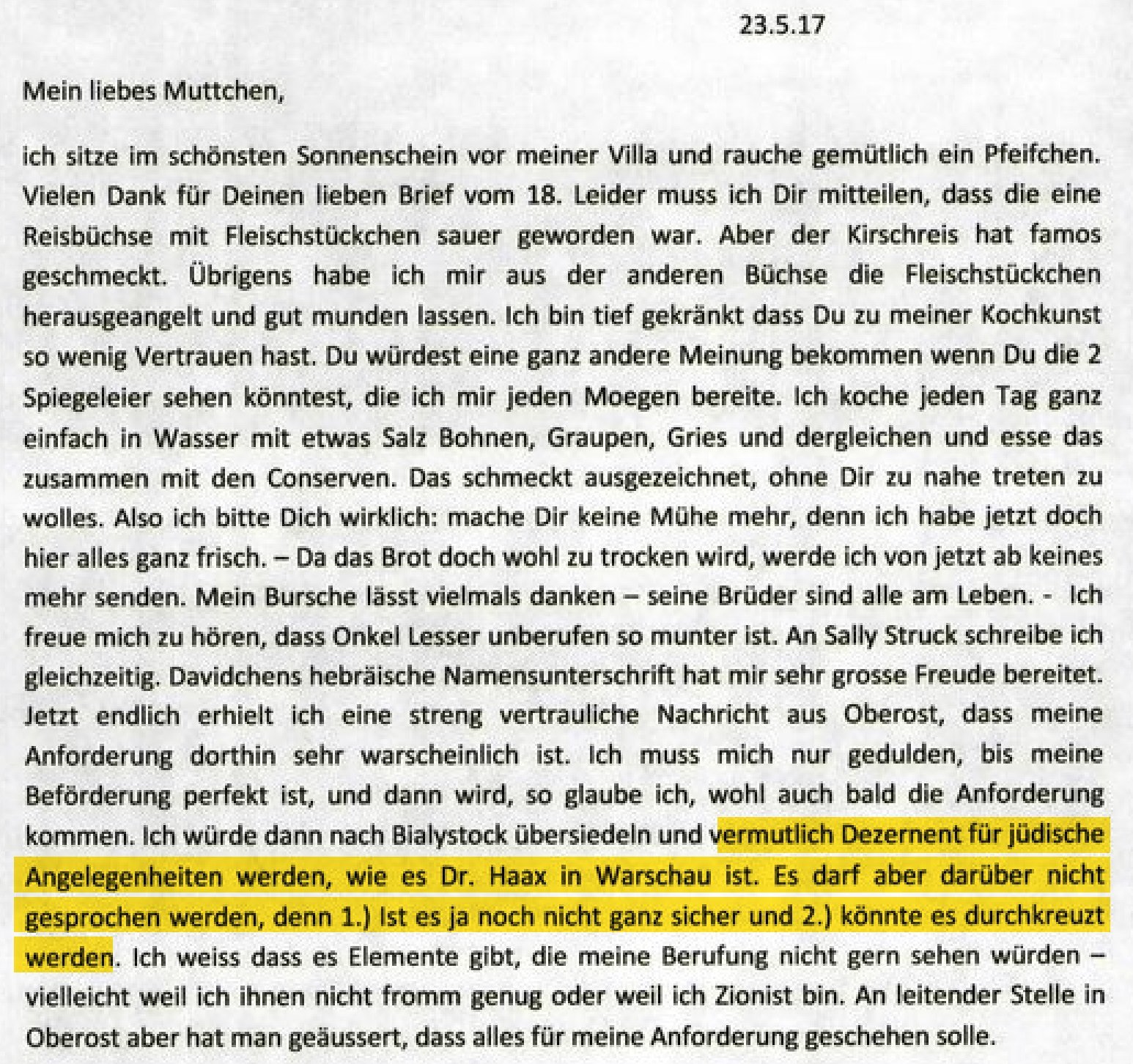
He added that there were people who would not want his appointment, "perhaps because I am not religious enough for them, or because I am a Zionist", but that at the top of the military government in the East, Ober Ost, they had said everything would be done to bring him there. The letter is kept in the same archive, in the file of Struck's personal correspondence with his family during the war, G.F.0353/11, letter 22, in his handwriting and in the archive's transcript.
1917: Bialystok
The appointment came. A pass dated 30 July 1917 identifies him as "Leutnant Struck, of the staff of the Supreme Commander in the East", and allows him to cross the borders of the occupied territory at any time and to requisition carts and cars. A day earlier he had written to his family from the palace in Bialystok, where the headquarters sat:
Ob mir auch die Schulen unterstellt werden, weiss ich noch nicht.
"Whether the schools will also be placed under me, I do not know yet." In the same letter he wrote that he was dealing with "the question of drawing on Jews for our potato harvest", and that he had to act "with caution and tact" to meet the expectations of both sides, the government and the Jews.
According to the doctoral thesis of the historian Jan Rybak at the European University Institute (2019), Struck headed the department for Jewish affairs of Ober Ost from August 1917.
What was required of the schools
In 1917 the military government published an official book about itself, Das Land Ober Ost. In the chapter on schools, on page 376, it says:
Die Schulen haben religiöse Gesinnung zu pflegen, die Jugend an Gehorsam gegen die Gesetze, Achtung vor der deutschen Obrigkeit und ihrer bewaffneten Macht sowie an Zucht und Ordnung zu gewöhnen.
That is: the schools are to cultivate a religious disposition and to accustom the young to obedience to the laws, to respect for the German authorities and their armed power, and to discipline and order. On the same page: founding, opening, merging and closing any educational institution, as well as giving private lessons, "require the approval of the head of the administration". The language of instruction is the mother tongue, and Jews are taught religion "in their religious language".
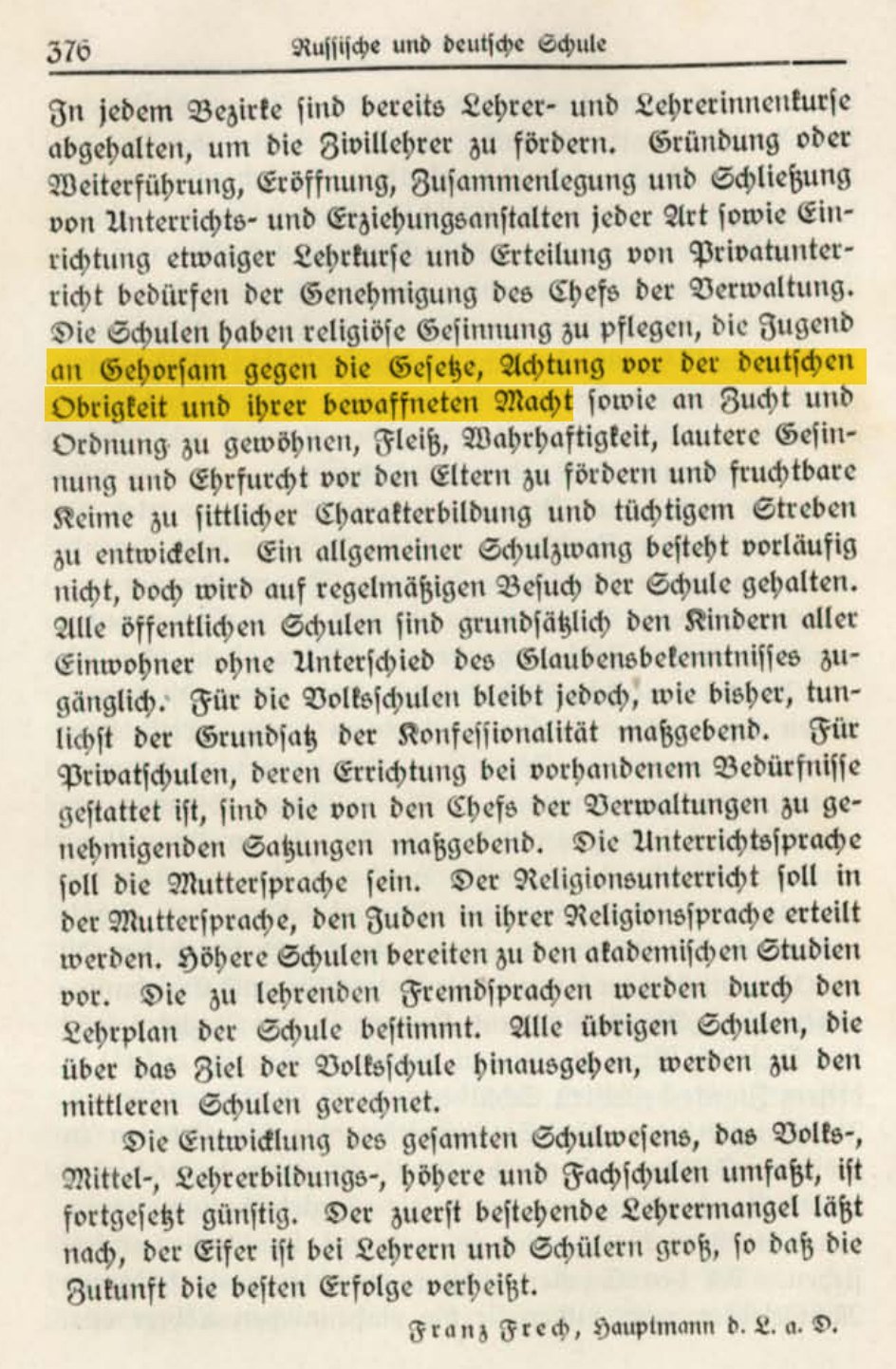
This is a rule of the military government, signed by Captain Franz Frech. No document was found in which Struck drafted, approved or enforced it. According to Rybak, Struck wrote on 26 February 1918 that the culture department of Ober Ost looked "very favourably" on opening Western education to the Jews of Vilna.
Haifa, 1925/26
The schools Struck was involved with after the war were different ones. In 1953 Shmuel Ben-Shabbat, head of the Mizrachi girls' school in Haifa, wrote to the head of another school: "The Mizrachi girls' school in Haifa was founded by the artist Prof. Hermann Struck in the year 5686 [1925/26]. He created it, he found its budget during its first years." The letter is quoted on the website of the Meir Ben-Uri museum. The original letter was not examined for this article, and no link was found between the Ober Ost rules and the school in Haifa.
1963: two hundred pounds
Struck died in Haifa in January 1944. The state religious school "Aharon" in Kiryat Shmuel was named after him after his death and was inaugurated at Hanukkah 1951. It is not the girls' school of 1925/26.
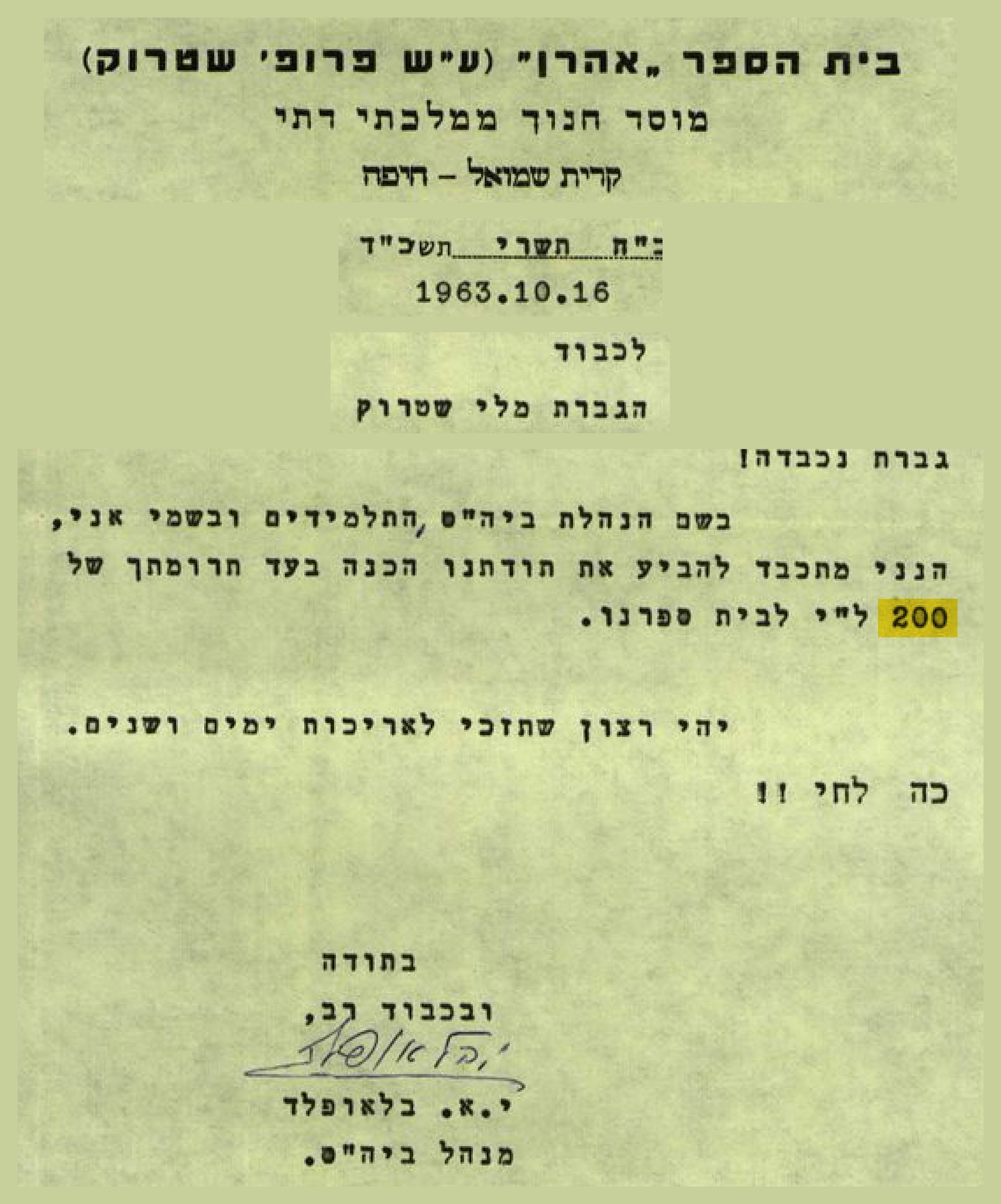
On 16 October 1963, twenty-seven years after the German certificate, the head of the Aharon school, Y. A. Blaufeld, sent a letter to his widow, Mally Struck:
"On behalf of the school's management, the pupils and myself, I have the honour to express our sincere thanks for your donation of 200 Israeli pounds to our school." (translated from Hebrew)
This letter too is kept in file G.F.0353/10, a few pages after the 1936 certificate.
What is documented and what is not
Documented: the 1936 certificate and its wording; the 1917 letter to his mother and the fear that the appointment would be thwarted; the letter from Bialystok and the question of whether the schools would be placed under him; the school rules of Ober Ost; the 1963 thank-you letter.
Not documented: who decided on the appointment, and exactly when; any role of Struck in drafting the school rules; and any link between the decoration, the appointment and the donation. These are three documents from three periods, kept in the same collection.
Sources
- Archive for German-speaking Jewry in Israel, Hermann Struck collection, G.F.0353/10: certificate of the Cross of Honour, 10.3.1936 (p. 11 of the scan); letter of the Aharon school to Mally Struck, 16.10.1963 (p. 25); accession register (pp. 1 to 2). Scan at the National Library of Israel, NNL_ARCHIVE_AL11541922380005171.
- Archive for German-speaking Jewry in Israel, Hermann Struck collection, G.F.0353/11, personal correspondence with the family during the First World War: letter 22, 23.5.1917; letter 32, 29.7.1917. Scan at the National Library of Israel, NNL_ARCHIVE_AL11541891660005171.
- Archive for German-speaking Jewry in Israel, Hermann Struck collection, G.F.0353/13, official documents: pass, 30.7.1917. Scan at the National Library of Israel, NNL_ARCHIVE_AL11541892180005171.
- Das Land Ober Ost. Deutsche Arbeit in den Verwaltungsgebieten Kurland, Litauen und Bialystok-Grodno, Stuttgart und Berlin: Deutsche Verlags-Anstalt, 1917, chapter "Russische und deutsche Schule", p. 376.
- Jan Rybak, Everyday Zionism in East-Central Europe, 1914-1920, PhD thesis, European University Institute, 2019, pp. 62, 158.
- Share certificate of The Mizrahi Bank Ltd, 2.11.1924, Barlev collection.
- Meir Ben-Uri museum website, "Prof. Hermann, Haim Aharon ben David Struck", January 2025.
- Hebrew Wikipedia, entry "Hermann Struck".
About this article: the article is based on original scans from the Hermann Struck collection in the Archive for German-speaking Jewry in Israel. The German quotations were read from the scans themselves, and the translations are the editors'. AI assisted with reading, translation and drafting. This is not legal advice.