In Jerusalem, on 2 November 1924, a share certificate of The Mizrahi Bank Ltd. was issued: one ordinary share of one Egyptian pound. On the Directors line the signature reads Hermann Struck. According to the securities-certificate collection of the accountant Yehuda Barlev, Struck also designed the certificate.

This article is about what Struck did eight years earlier, during the First World War. It rests on four sources: the book of drawings he published in 1916, his personal papers kept in the Archive for German-speaking Jewry in Israel, the research of the historian Jan Rybak (2019), and the share certificate itself.
Struck's position at the bank
Mizrahi Bank was founded in 1923 by the World Mizrachi movement. Struck signed the share certificates as a director. No source was found for him managing a branch.
1916: the book and the drawings
In 1916 the book Skizzen aus Litauen, Weissrussland und Kurland appeared in Berlin: sixty drawings by Struck, each facing a short text. It was printed at the press of the Supreme Commander in the East and dedicated to General Ludendorff. The preface is signed by Struck and the writer Herbert Eulenberg together. The texts beside the drawings are attributed to Eulenberg. Review of the book.
The newspaper girl. Beside a drawing of a girl selling the German newspaper Kownoer Zeitung the text reads: "Here is a groschen for you, little Polish girl!" (original: Hier hast Du einen Groschen, kleine Polin!).
The Jewish porter. Beside a drawing of an old porter a whole scene is printed. "The Westerner", a German arriving in the East for the first time, says that Jews are surely only rich people, who pile up money or lend it, "of course only at high interest". He looks at the old man from the side: "Right! In profile it could fit" (original: Richtig! Es kann stimmen im Profil). He then asks how much the old man earns, gives him fifty pfennig and asks whether he takes German money. The scene ends with the porter's thought: "What questions a goy can ask!".
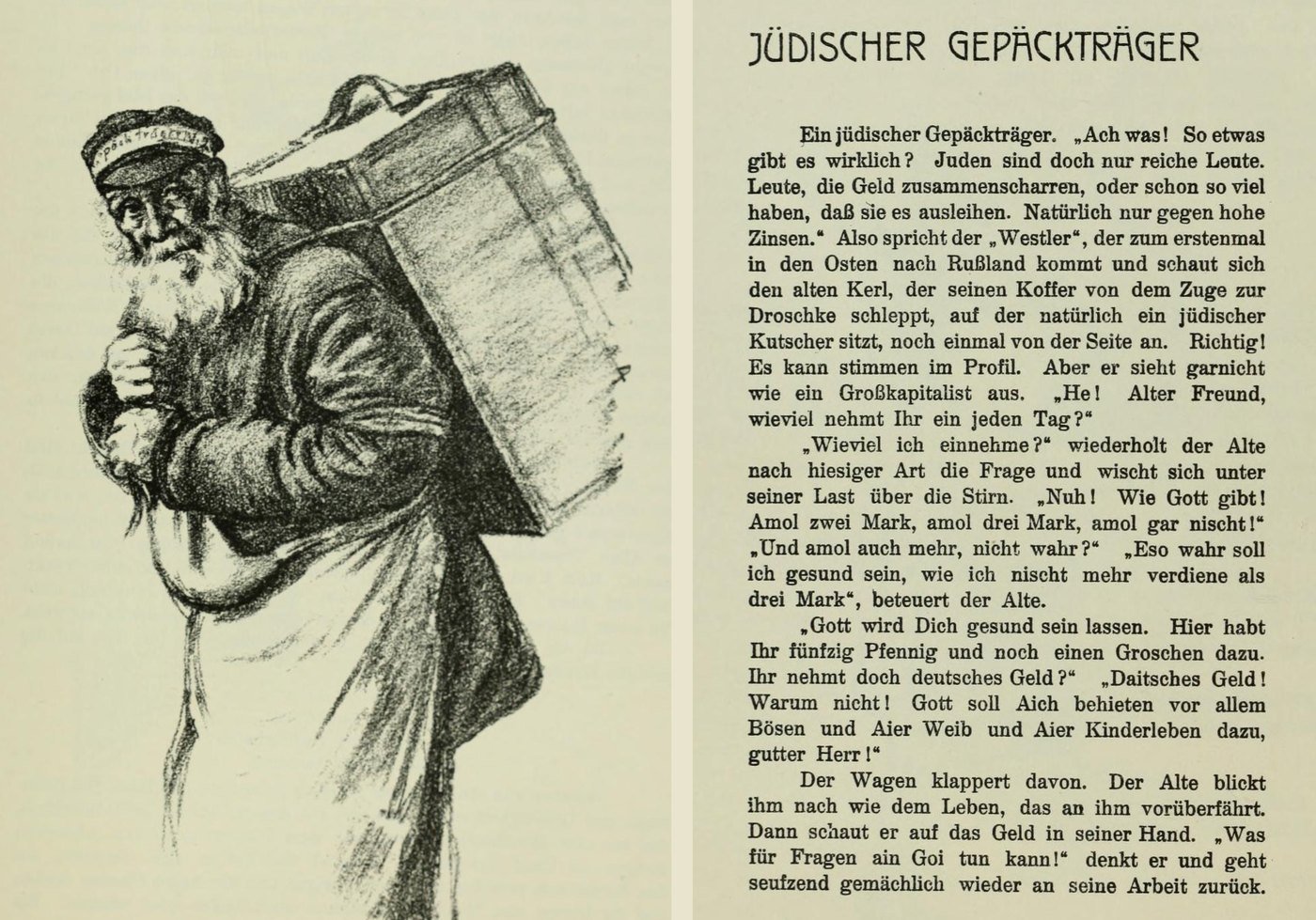
The text opens with the stereotype of the rich Jew and refutes it with the figure of the poor porter. The viewpoint it is written from, however, is that of the German who comes from outside.
The posts in Ober Ost
Ober Ost was the German military government of the territories taken from Russia: Lithuania, Courland and the Bialystok and Grodno area. Struck volunteered for the army when the war broke out and was posted to the Eastern Front in 1915.
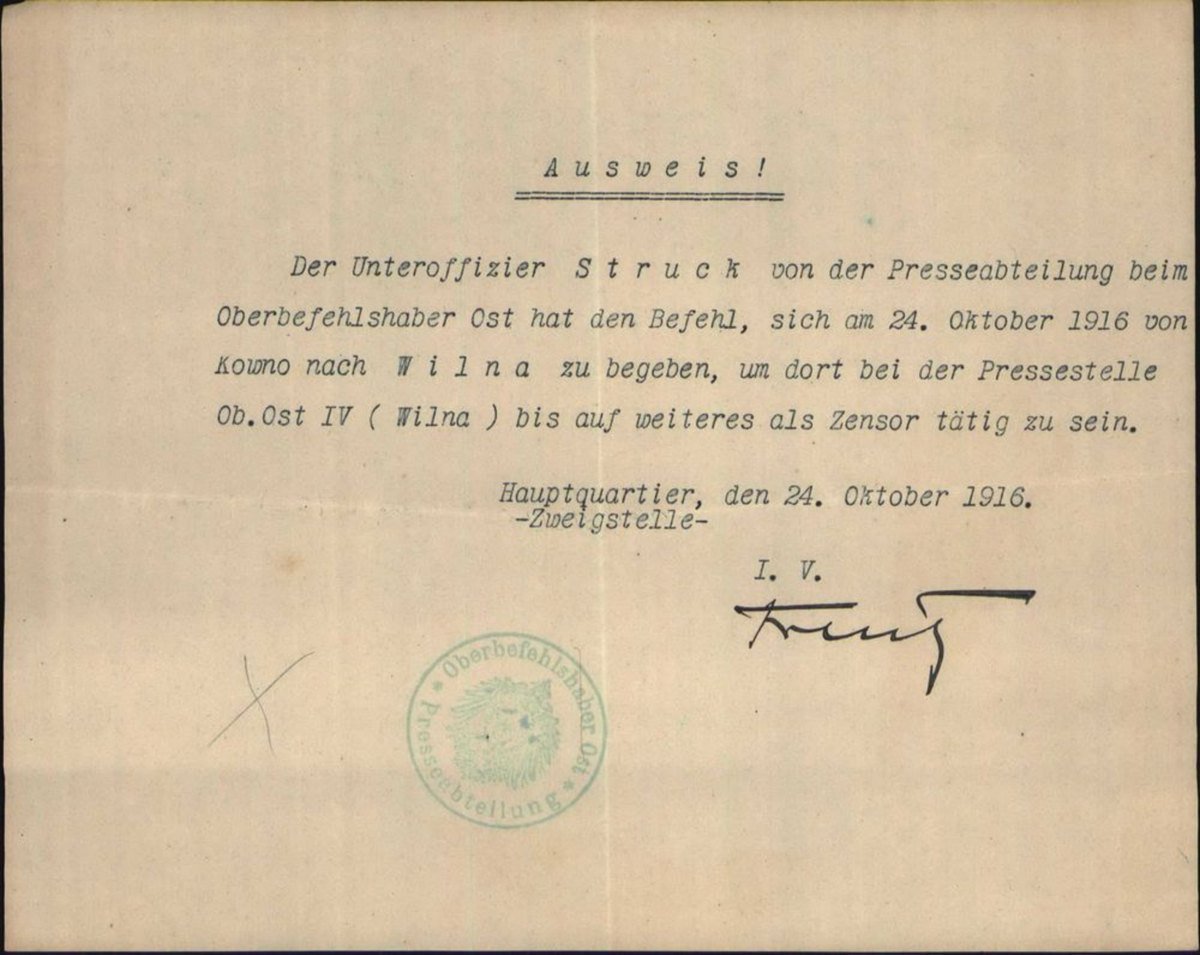
- Censor. On 14 March 1916 the Committee for the East told its branches that its member Hermann Struck had been appointed censor in Ober Ost (Rybak, p. 62). His papers contain an order of 24 October 1916: he is to move from Kowno to Wilna to work there as censor until further notice (original: als Zensor tätig zu sein).
- The censorship directive. The same file holds a secret directive of the press department dated 3 February 1916, signed by the Chief of the General Staff. Point 3 says that reports directed against the German administration, or unfavourable descriptions of the mood of the population, are to be suppressed (original: sind zu unterdrücken). Point 6: all anti-Russian and pro-German tendencies are to be promoted. Struck did not write the directive. It is the directive under which the department he served in worked.
- Adviser. According to Rybak, Struck's diary suggests he was "more than a censor": a counsellor to the heads of the administration on the Jewish population.
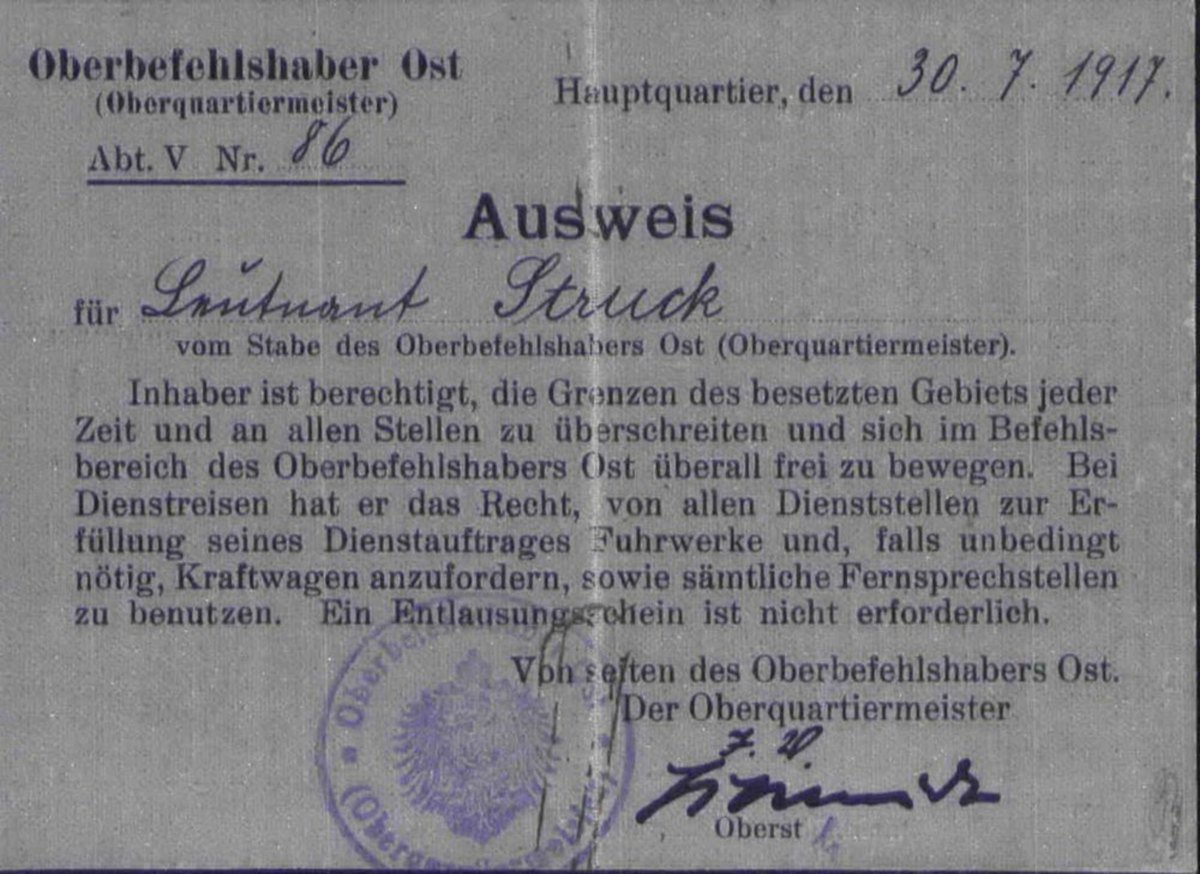
- Head of the department for Jewish affairs. The department was founded in August 1917 and Struck headed it (Rybak, p. 62). A pass dated 30 July 1917 is made out to "Leutnant Struck".
Recruiting workers
On 29 July 1917 Struck wrote to his family from Bialystok: "I am now dealing with the question of drawing on Jews for our potato harvest" (original: Heranziehung von Juden für unsere Kartoffelernte).
In October 1917, according to Rybak (p. 120), he was given the right to organise privately the recruitment of Jewish workers from the territory. Rybak presents this recruitment as a possible alternative to forced recruitment. He also writes that the "voluntary" labour units in Ober Ost were often nothing but renamed forced-labour battalions. In November 1917 Simon Rosenbaum, the leader of the Zionists of Wilna, sharply criticised the fact that workers for Ober Ost had been recruited by Struck, because it tied the Zionist movement to that system (Rybak, p. 122).
The sources do not say that Struck forced anyone to work.
What was not found
- No source links Mizrahi Bank to Ober Ost. The bank was founded five years after the war ended.
- The bank is not mentioned in the Struck papers examined at the archive, about 500 pages.
Sources
- Hermann Struck, Herbert Eulenberg, Skizzen aus Litauen, Weissrussland und Kurland, Berlin: Georg Stilke, 1916. Scan at archive.org.
- Archive for German-speaking Jewry in Israel, Hermann Struck collection, G.F.0353: the censor order (24.10.1916), the censorship directive (3.2.1916), the pass (30.7.1917), letter 32 (29.7.1917).
- Jan Rybak, Everyday Zionism in East-Central Europe, 1914-1920, PhD thesis, European University Institute, 2019, pp. 62, 120, 122.
- Share certificate of The Mizrahi Bank Ltd., Jerusalem, 2.11.1924, Yehuda Barlev collection.
About this article: every quotation was checked against the source. Translations from German are by the editors. AI assisted with translation and drafting. This is not legal advice.