When no one comes to ask for the money, the bank is the only one that knows it is there. That is where a bank's fiduciary duty is really tested: not against a customer who argues, but against an account no one asks about. The legal framework is set out on the section page.
All quotes are from appendix 3 to the report of the Knesset parliamentary inquiry committee on locating and restoring the assets of Holocaust victims: "Findings of the examination at United Mizrahi Bank Ltd", prepared by the accounting firm Caspi Et Caspi & Co. between December 2001 and July 2003. Quotes are translated from Hebrew.
In brief
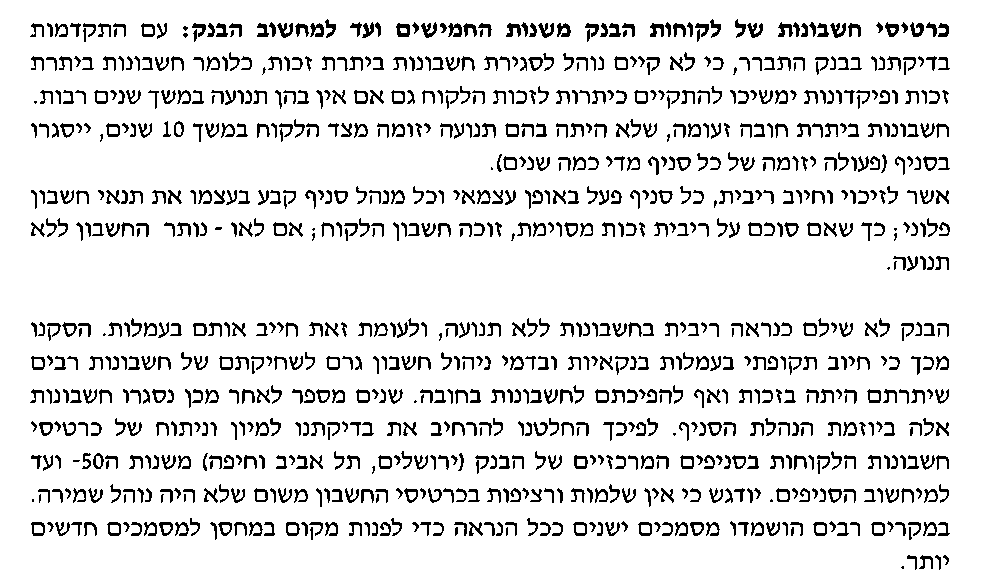
- The bank had no procedure for closing accounts in credit. An account with a "meagre debit balance" and no customer activity for 10 years was closed by the branch.
- "The bank apparently did not pay interest on accounts without activity, and on the other hand charged them fees."
- According to the auditors, the fees eroded credit balances and turned them into debit balances, and those accounts were closed.
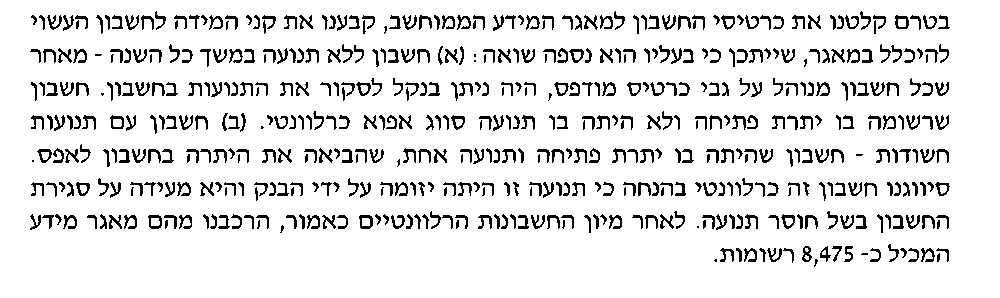
- From the account cards in Jerusalem, Tel Aviv and Haifa the auditors built a database of about 8,475 records.
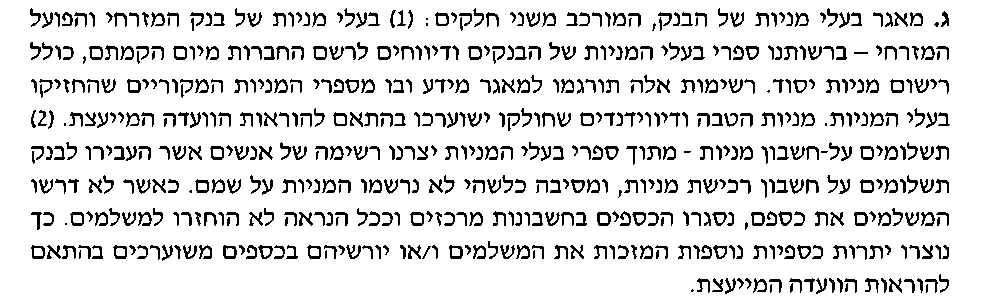
- 136 shareholders paid for shares that were never allotted to them, and the money "apparently was not returned".
How a credit account becomes a debit account
The auditors found that the bank had "no procedure for closing accounts with a credit balance". On paper, a customer's money stayed his even after years without activity. By contrast, "accounts with a meagre debit balance, in which there was no activity initiated by the customer for 10 years, will be closed at the branch".
Interest terms were not set by management: "each branch manager set the terms of a given account himself". Then the central finding: "The bank apparently did not pay interest on accounts without activity, and on the other hand charged them fees. We concluded that periodic charging of bank fees and account management fees caused the erosion of many accounts whose balance was in credit, and even turned them into debit accounts. Several years later these accounts were closed at the initiative of the branch management."
Put simply: the rule against closing a credit account did not protect the account. The fees turned it into a debit account, and for debit accounts there was a closing procedure.
8,475 records
Following this finding, the auditors extended the examination to account cards at the main branches in Jerusalem, Tel Aviv and Haifa, from the 1950s until the branches were computerised. They also classified as relevant "an account with an opening balance and one movement that brought the balance to zero", "on the assumption that this movement was initiated by the bank and indicates closure of the account for lack of activity". The resulting database contains about 8,475 records.
The report itself adds a caveat: "there is no completeness or continuity in the account cards, because there was no retention procedure". We wrote about the lost documents in a separate article.
136 shareholders who paid and received no shares
According to the report, "some of the shareholders, who bought their shares abroad, also opened an account at the bank and deposited money in it for Zionist reasons". The auditors found "136 shareholders who paid for rights to shares that had not yet been allotted to them".
What happened to the money, according to the report's summary: "When the payers did not claim their money, the funds were closed in central accounts and apparently were not returned to the payers."
The dividends cannot be reconstructed either. The documents filed with the Registrar of Companies up to the 1980s "were burned, and therefore the distribution of dividends and benefits cannot be reconstructed". The auditors wrote that "the question of compensating the shareholders should be considered in another way".
The safe deposit boxes
On the safe deposit boxes the auditors were given two versions. The head of the bank's legal department said each branch that opened a box notified the Administrator General and kept the contents. The chief security officer said his predecessor collected the contents of boxes that were broken open and transferred them to the main branch in Tel Aviv. In their summary the auditors wrote: "It is possible that the branch managers of the time cleared the boxes that had no activity and took up space, without proper recording."
What this says about the fiduciary duty
When the customer does not come, only the bank knows there is money in the account, only the bank decides whether to credit it with interest, and only the bank charges it fees. According to the auditors' findings at Bank Mizrahi, these decisions all pointed the same way: no interest paid, fees charged, account closed.
What we do not know
The auditors wrote "apparently". This is a conclusion drawn from the account cards, not a document of bank management. The report does not detail a specific account that was eroded and closed, and gives no total for the fees. The name databases are not necessarily names of Holocaust victims, because under the committee's instructions the auditors were not allowed to cross-check them with the Yad Vashem database. The bank disputed some of the committee's findings, and in 2012 paid NIS 9.5 million in a settlement, without admitting liability.
Responses
Any response from Mizrahi Tefahot Bank will be published here in full.
The documents
- Appendix 3 of the inquiry report: the Bank Mizrahi examination, selected pages (PDF, Hebrew)
- Full appendix 3 on the Knesset website (PDF, Hebrew)
Based on appendix 3 to the report of the parliamentary inquiry committee on locating and restoring the assets of Holocaust victims, pages 5, 6, 7, 17 and 18. Quotes are translated from the Hebrew original. The Hebrew version of this article prevails. This is not legal advice.